


Yes, red light therapy can help many soft tissue injuries heal. It gives injured cells more energy, calms inflammation, improves blood flow, and can ease pain. It works best as one part of a structured rehab plan, not as a stand-alone fix.
As a sports physical therapist, I get asked about red light every week. Athletes want to know if it will get them back on the field sooner. Weekend warriors want to know if a home panel is worth the money. The answer depends on the injury, the dose, and what else you are doing to recover. This guide walks through all of it, from how the light works to which injuries respond best, so you can decide whether red light therapy sessions at Rehabletics or a home device fits your recovery. If you are dealing with a fresh strain or a nagging problem, it also helps to understand where light fits inside complete sports injury treatment.
Key takeaways
- Best-supported uses: tendon pain, muscle strains, and post-exercise muscle recovery.
- Typical session: 10 to 20 minutes per area, 3 to 5 times a week.
- Typical timeline: many people notice less pain within 1 to 4 weeks; chronic tendon problems take longer.
- What it cannot do: reconnect a fully torn ligament or tendon, or fix the movement problem that caused the injury.
What Is Red Light Therapy?
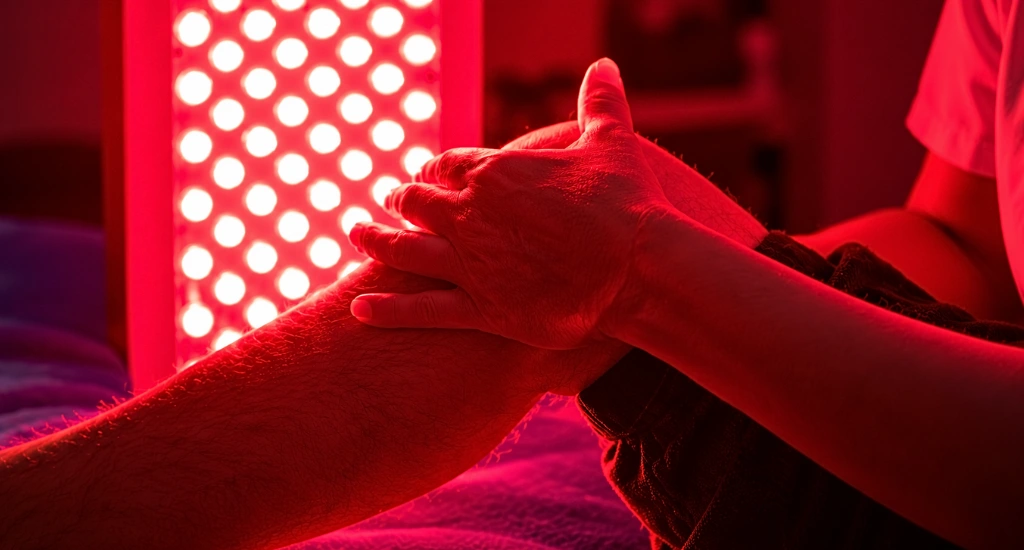
Red light therapy is a non-invasive treatment that shines specific wavelengths of red and near-infrared light onto the skin to support healing in the tissue below. Researchers call it photobiomodulation (PBM). You may also see it called low-level light therapy or low-level laser therapy (LLLT).
It is not a tanning bed, and it does not use ultraviolet light. Treatment devices produce little or no heat, so they do not damage tissue. Most people feel nothing at all, or a gentle warmth. Light comes from LED panels, flexible wraps, handheld wands, or clinical lasers.
Red Light vs Near-Infrared Light: Why Wavelength Matters
Wavelength decides how deep the light travels. That matters for injuries, because most of them sit well below the skin.
| Light type | Wavelength range | How deep it reaches | Best for |
| Red light | 630 to 660 nm | Skin and superficial tissue | Surface wounds, incisions, superficial muscle soreness |
| Near-infrared light | 810 to 850 nm | Deeper muscle, tendon, ligament, and joint tissue | Strains, sprains, tendinopathy, deep joint pain |
For most sports injuries, you want a device that includes near-infrared light, or a combination of both.
What Does Red Light Therapy Do for Injuries?
Red light therapy works at the cellular level. Here is what happens in injured tissue when the right dose of light reaches it.
It Gives Injured Cells More Energy
Light is absorbed by the mitochondria, the energy centers inside your cells. This helps cells produce more ATP, the fuel they use to repair damage. Injured tissue needs a lot of energy to rebuild, so extra fuel can speed up the work.
It Helps Calm Inflammation and Swelling
Inflammation is a normal and necessary part of healing. The problem starts when it lingers. Research shows light can help shift the inflammatory response so it settles sooner, which often means less swelling and stiffness.
It Improves Blood Flow to the Area
Red and near-infrared light trigger the release of nitric oxide, which widens blood vessels. Better circulation brings oxygen and nutrients into the injured area and carries waste products away.
It Supports Collagen for Tendon and Ligament Repair
Collagen is the protein that gives tendons and ligaments their strength. Lab studies show red light therapy can increase collagen production and help the new fibers line up in a more organized way. This is a key reason it is used for tendon repair.
It Can Reduce Pain
Light appears to calm pain signaling in nerves and reduce the chemical irritants in injured tissue. Less pain means you can move and load the area sooner, which is what drives real recovery.
These effects create a better environment for healing. However, they do not replace the exercise and loading that rebuild tissue strength.
Which Injuries Can Red Light Therapy Help?
Red light therapy for injury recovery is most useful for soft tissue problems: muscles, tendons, and ligaments. Here is a quick overview before we go injury by injury.
| Injury type | Examples | How red light may help | Strength of evidence |
| Tendon injuries | Patellar tendonitis, Achilles tendinopathy, tennis elbow | Less pain, better function, collagen support | Good |
| Muscle injuries | Hamstring strain, quad strain, pulled calf, post-workout soreness | Faster recovery, less soreness, reduced muscle damage | Moderate |
| Ligament injuries | Ankle sprain, MCL tear | Pain and swelling relief, healing support | Early |
| Overuse injuries | Repetitive strain, shin pain, thrower’s shoulder | Symptom relief while load is managed | Moderate |
| Post-surgical recovery | Repaired tendons, reconstructed ligaments, incisions | Pain, swelling, and tissue healing support | Early |
Muscle Strains, Pulled Muscles, and Torn Muscles
A pulled muscle is a strain: the fibers have been overstretched or partly torn. Hamstring strains, quad strains, and calf strains are the most common in athletes. Red light therapy for muscle injury can reduce soreness, lower markers of muscle damage, and support the collagen that patches small tears.
Mild and moderate strains (grade 1 and 2) are a good fit for light alongside rehab. A complete tear (grade 3), where you felt a pop and lost strength, needs a medical exam first. If your strain keeps flaring, our approach to treating muscle strains explains how we rebuild strength, and athletes with posterior thigh pain can learn more about hamstring injury rehab.
The same principles apply to quads and hamstrings after heavy training, and to arm muscle soreness after a hard lifting or throwing day.
Sprains and Ligament Injuries (Ankle Sprains and MCL Tears)
A sprain is a stretched or torn ligament. Does red light therapy help ligaments heal? It can support the process. Ligaments have a poor blood supply, which is why they heal slowly, and light may help by improving circulation and collagen production. Research here is promising but still early, so think of it as support rather than a cure.
Partial MCL tears often heal without surgery, and red light can be a useful extra during that rehab. A fully torn ACL, on the other hand, does not reconnect with any amount of light. For rolled ankles, see how we handle ankle sprain and ankle pain care, including the balance work that prevents the next sprain.
Tendon Injuries and Tendonitis (Patellar, Achilles, and Elbow)
Tendons are where red light therapy has the strongest research. Studies on patellar tendonitis, Achilles tendinopathy, and tennis elbow show meaningful drops in pain and better function. The tendon repair benefits come from improved collagen production and calmer local inflammation.
There is one catch. Tendons only get stronger when they are loaded with progressive exercise. Light makes that loading more comfortable; it does not replace it. Our tendinopathy treatment page explains how the two work together, and our guide to red light for tendonitis goes deeper on protocols.
Rotator Cuff Tears and Shoulder Injuries
A common question about red light therapy for a rotator cuff tear is whether the light can even reach the tendon. Fair point. Red light alone stays near the surface, but near-infrared light travels deeper and can reach the rotator cuff in most people.
Red light helps most with rotator cuff tendinopathy and the pain of partial tears. A full-thickness tear may need surgical repair. Our shoulder pain physical therapy starts with finding out exactly which structure is involved. If you already had surgery, read about recovering after rotator cuff repair.
Overuse and Repetitive Strain Injuries
Runners, pitchers, swimmers, and lifters often develop pain from repeating the same motion thousands of times. Red light therapy for overuse injuries can quiet symptoms, but the real fix is changing training load and mechanics. Learn how our overuse injury care addresses both sides.
Post-Surgical and Orthopedic Recovery
After orthopedic surgery, red light can support incision healing, reduce swelling, and ease pain during the early phase. Always get clearance from your surgeon before using light over a fresh repair. In our post-surgical rehabilitation program, recovery tools are timed to match each stage of healing.
What Does the Research Say About Red Light Therapy for Injuries?
The research is promising, with the strongest support for tendon pain and exercise-related muscle recovery. Evidence for ligament injuries and acute sprains is smaller and more mixed.
Here are the highlights:
- Tendinopathy: A 2021 systematic review and meta-analysis of randomized controlled trials, published in BMC Sports Science, Medicine and Rehabilitation, found that red and near-infrared photobiomodulation reduced pain and improved function in people with tendinopathy.
- Return to play: A 2016 study of 395 athletes treated with 830 nm light reported an average return to play of about 9.6 days, compared with an anticipated 19.2 days. This was not a controlled trial, so it shows potential rather than proof.
- Muscle recovery: Multiple trials show light before or after exercise can reduce soreness and markers of muscle damage.
- Tissue repair: Lab and animal studies show faster collagen production and better organized repair in muscle and tendon.
There are also limits. Many trials are small, and studies use very different wavelengths, doses, and devices, which makes results hard to compare. That is why a guided protocol matters more than simply owning a device.
How Long Does Red Light Therapy Take to Heal an Injury?
Most people notice less pain within 1 to 4 weeks of consistent use. Full tissue healing takes longer and depends on the injury.
| Injury | When people often notice a change | Typical course with rehab |
| Mild muscle strain | A few sessions | 1 to 3 weeks |
| Mild to moderate ankle sprain | First 1 to 2 weeks | 2 to 6 weeks |
| Tendinopathy | 2 to 4 weeks | 8 to 12 weeks or more |
| Post-surgical recovery | Varies | Follows your surgeon’s and therapist’s plan |
Red Light Therapy for a Sprained Ankle: How Long?
For a mild or moderate ankle sprain, people often use red light 3 to 5 times a week for 2 to 4 weeks, alongside balance and strength exercises. Swelling and pain usually improve first. Ligament strength returns more slowly, which is why rehab continues after the pain fades.
Chronic and Overuse Injuries Take Longer
A tendon that has hurt for months has changed structurally. Expect 8 to 12 weeks of light activity combined with progressive loading. Consistency matters more than intensity.
How to Use Red Light Therapy for Injury Recovery
Good results come from the right timing, the right dose, and steady use.
When to Start After an Injury
Many protocols start within 24 to 48 hours of an injury. In the first few days, avoid any device that produces noticeable heat over hot, swollen tissue. If you suspect a fracture, a full tear, or a dislocation, get examined before starting any home treatment.
Session Length, Distance, and Frequency
- Session length: 10 to 20 minutes per area.
- Distance: about 6 to 12 inches from the skin for panels, or follow your device’s guidance. Wraps sit directly on the skin.
- Frequency: 3 to 5 sessions per week during active recovery.
- Coverage: treat the whole injured region, not just the most painful spot.
- Eye safety: wear the goggles supplied with the device and never stare into the light.
- Timing with training: use it after training to support recovery, or before training to ease stiffness.
Why More Light Is Not Better
Red light therapy follows a biphasic dose response. A small to moderate dose helps, while too much can cancel out the benefit or even slow healing. Doubling your session time will not double your results. Stick to the recommended dose and let the light work alongside your rehab.
Best Red Light Therapy for Injury: Clinic Sessions vs At-Home Devices
The best option depends on your injury, your budget, and how much guidance you need.
| Option | Power and depth | Coverage | Guidance | Best use |
| Clinic-grade panel or laser | High; reaches deeper tissue | Large or targeted | Clinician sets the dose | Active injuries and stubborn pain |
| At-home panel | Moderate to high | Large | Self-guided | Ongoing recovery and maintenance |
| Wrap or pad | Lower | One joint or muscle | Self-guided | Knees, elbows, ankles, shoulders |
| Handheld wand | Lower | Small spot | Self-guided | Small areas and travel |
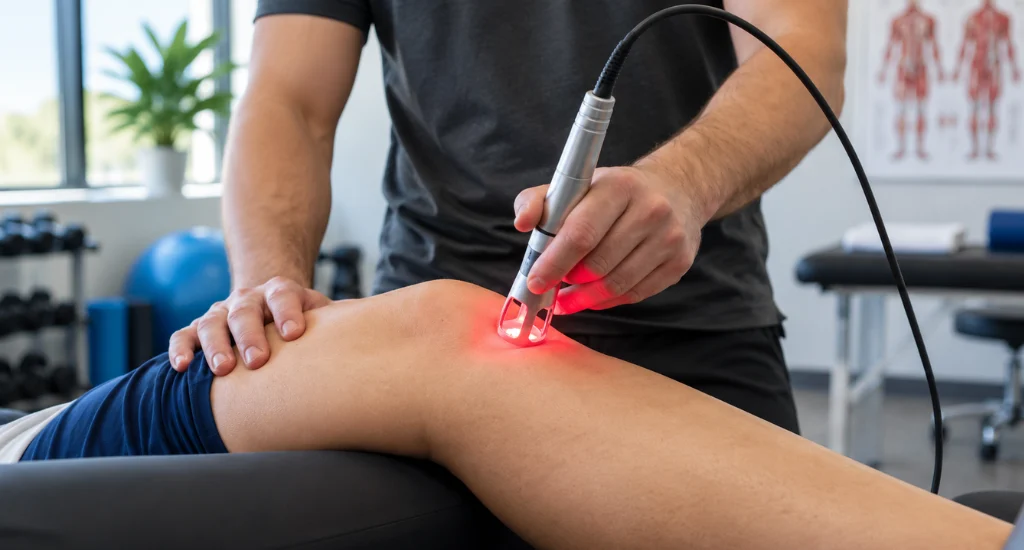
If you buy a home device, look for near-infrared wavelengths (810 to 850 nm), published irradiance numbers, FDA clearance, and a size that covers the injured area. Clinics also use clinical laser therapy, which delivers a more concentrated dose to a specific spot. It is often the better choice for deep or focused problems.
Red Light Therapy vs Other Injury Treatments
Red light therapy is a recovery tool. It stacks well with other treatments rather than competing with them.
| Treatment | What it does | Best for | Works with red light? |
| Ice or cold therapy | Numbs pain and limits early swelling | First days after an injury | Yes, on different days or at different times |
| Laser therapy | Delivers concentrated light to a focused area | Deep or localized pain | Yes |
| Shockwave therapy | Sends acoustic waves that restart healing in stuck tissue | Chronic tendinopathy and plantar fasciitis | Yes |
| Manual therapy | Uses hands-on work to improve mobility and ease tension | Stiff joints and tight muscles | Yes |
| Exercise and loading | Rebuilds strength and tissue capacity | Every injury | Essential |
For tendons that refuse to improve after months of care, shockwave therapy for stubborn tendons is often the next step. Exercise remains the one treatment no injury plan can skip.
Is Red Light Therapy Safe? Side Effects and Who Should Avoid It
Red light therapy is safe for most people. It uses no UV light and does not damage skin.
Possible side effects are mild:
- Warmth or redness on the skin
- A temporary flare of soreness after the first few sessions
- Eye strain if you look directly at the light
Check with a provider first if you:
- Are pregnant and the treatment area is near the abdomen
- Take medications that make you sensitive to light
- Have active cancer or a suspicious skin spot in the treatment area
- Have light-triggered seizures, or plan to treat over the thyroid or eyes
Some symptoms need an exam, not a light panel: a pop with instant swelling, being unable to bear weight, a joint that gives way, numbness, or visible deformity.
Why Red Light Therapy Works Best as Part of a Rehab Plan
Red light therapy improves the healing environment, but it cannot teach a hamstring to handle sprinting again or correct the knee collapse that strained your tendon. Progressive strength work, mobility, and movement retraining do that.
Picture a soccer player with a grade 2 hamstring strain. Light in the first weeks eases pain and supports repair. Meanwhile, the rehab plan moves from gentle isometrics to eccentric strength work, then to a graded return to running and sprinting. Skip the strength work and the injury often returns, which is exactly why sports injuries keep coming back. For a closer look at training recovery, read how athletes use red light for recovery.
Red Light Therapy for Injury Recovery in Cherry Hill, NJ
At Rehabletics, red light therapy is part of our REPAIR Lab, the recovery wing of our clinic. It sits alongside PEMF, EMTT, blood flow restriction training, IV therapy, and an infrared sauna. That is the same kind of recovery technology used by professional teams, now available to athletes and active adults in South Jersey.
Care is led by Dr. Jaime Mor, PT, DPT, ATC, founder of Rehabletics and a physical therapy contractor for the Philadelphia Flyers and Philadelphia Eagles. We start with a one-on-one evaluation to find the cause of your injury, then add red light where it will speed your progress. PT patients can stack it on top of rehab, and anyone can book REPAIR Lab sessions on their own or through a membership. In New Jersey, you can also see a physical therapist without a referral.
To learn more about local options, read about red light therapy in Cherry Hill. We are at 5 Esterbrook Lane, Cherry Hill Township, NJ 08003. Ready to get back to your sport? Book a free consultation or call (609) 354-7987.