


Your legs still feel heavy on day three. The session that was supposed to build you is now costing you training days. Red light therapy for athletes has become the tool people reach for at just the right moment. It is also the one they argue about most.
Some coaches call it the biggest recovery upgrade since sleep tracking. Dr. Jeff Sankoff, an emergency physician and IRONMAN coach writing for TrainingPeaks, called it a novelty not worth the investment. Both camps are reading the same research.
This guide separates what is proven from what is oversold. You get the mechanism, the honest evidence, exact wavelengths and doses, timing around training, and a device framework you can act on. Read on.
What Is Red Light Therapy for Athletes?
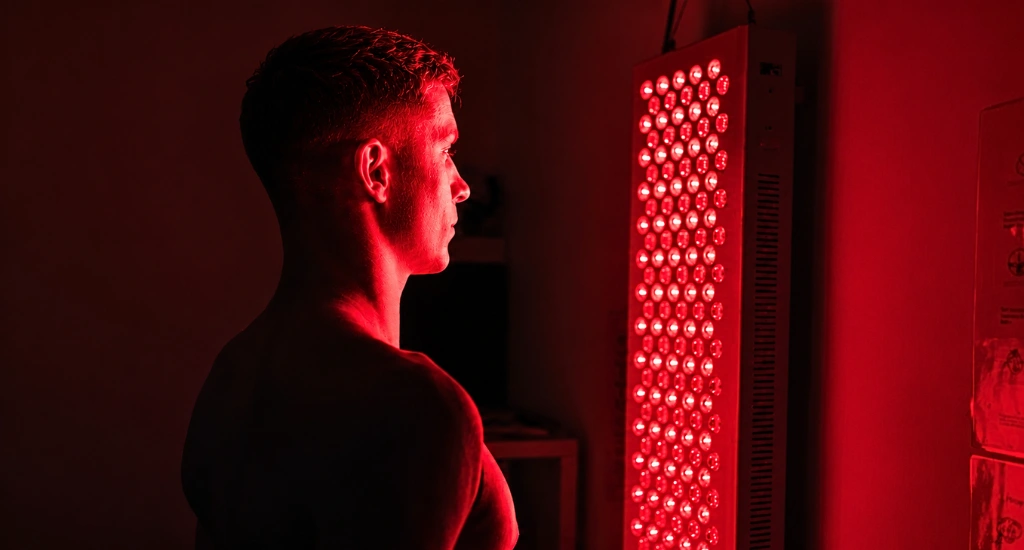
Red light therapy is the use of red and near-infrared wavelengths to stimulate energy production inside cells. Clinicians call it photobiomodulation (PBM). Older names include low-level laser therapy (LLLT) and light-emitting diode therapy (LEDT).
The light is non-thermal and carries no UV. It does not burn, tan, or heat tissue the way an infrared sauna does. Devices deliver it through LED arrays or laser diodes held close to bare skin.
Athletes use it for one reason. Working muscle runs on mitochondria, and this light appears to make mitochondria produce more fuel.
Red Light vs. Near-Infrared: Which One Reaches Muscle?
Red light (600–700 nm) treats skin, fascia, and shallow tendons. Near-infrared (780–950 nm) penetrates roughly 2–3 cm, which covers most muscle bellies. For hamstrings, quads, and glutes, near-infrared does the real work. The best devices emit both.
How Red Light Therapy Works Inside Muscle Cells
Red light therapy works by delivering photons that cytochrome c oxidase absorbs. Cytochrome c oxidase is an enzyme in the mitochondrial respiratory chain, and it is the main light-sensitive target in muscle tissue.
Four things follow. ATP production increases, providing the cell with more usable energy. Nitric oxide is released, widening small vessels and improving microcirculation. Oxidative stress falls, limiting the damage cascade after hard training. Gene expression shifts toward repair, activating fibroblasts and satellite cells.
Physiopedia summarises it simply: light absorbed by cytochrome c oxidase increases mitochondrial activity and the energy available to muscle. Everything else is a question of dose.
7 Red Light Therapy Benefits for Athletes
Red light therapy benefits for athletes cluster around recovery speed, pain, and training capacity. These are the seven with the most support behind them.
- Faster muscle recovery: Increased ATP and blood flow shorten the window between a hard session and the next quality one. This is the effect most athletes actually notice.
- Less delayed onset muscle soreness: A 2024 analysis by Li and colleagues found that photobiomodulation outperformed placebo in reducing muscle soreness 24 hours after training. The effect is strongest in the first 48 hours.
- Lower muscle and joint pain: Reduced inflammatory signaling makes it useful for muscle pain, stiff knees, and irritated tendons between sessions.
- Better endurance and time to exhaustion: Research from Dr. Cleber Ferraresi links pre-exercise light to more repetitions, longer time to exhaustion, and lower blood lactate.
- Strength and adaptation support: Ferraresi’s work also shows faster adaptation to training and improved strength gains when light is applied consistently alongside a program.
- Soft tissue repair: Fibroblast activity supports tendon, ligament, and muscle repair, which is why clinics use it as a rehab adjunct.
- Systemic recovery: Full-body red light therapy for athletes exposes large surface area at once, which some users pair with better sleep quality and lower whole-body fatigue.
What the Research Actually Says
The evidence for red light therapy’s effects on athletic performance is real but uneven. Sorting it into three honest buckets is more useful than a verdict.
Reasonably well supported: Reduced soreness at 24–48 hours, lower creatine kinase, and lower blood lactate appear across multiple trials. Physiopedia notes upper-limb studies are consistently more positive than lower-limb studies. Most articles skip that gap.
Mixed: Lower-body performance gains, hypertrophy, and long-term adaptation show inconsistent results. TrainingPeaks reviewed the same literature and found improvements in damage markers that did not translate into measurable performance.
Weak or absent: Rocha et al. (2022) found no meaningful effect for Achilles tendinopathy, likely a penetration-depth limit. No study has shown improved resilience to oxidative stress.
Two caveats matter. Some trials are manufacturer-funded, and most use clinic-grade equipment rather than the panel in your garage, as NBC Select reported. Runners Connect frames the realistic upside as a 3–5% edge. That is a genuine edge for a competitive athlete. It is not a transformation.
Red Light Therapy Protocol: Wavelength, Dose and Session Length
Dose determines whether red light therapy for muscle recovery works. These are the numbers used in the research, compiled from Sports Injury Physio and published PBM guidance.
| Goal | Wavelength | Irradiance | Dose | Session | Frequency |
| Exercise recovery | 630–680 + 800–860 nm | 20–30 mW/cm² | 3–8 J/cm² | 10–20 min per area | Post-session, with breaks |
| Deep muscle / DOMS | 850 nm | 20–30 mW/cm² | 10–30 J/cm² | 10–20 min | Within 0–2 h post-training |
| Muscle injury | 660–680 + 800–850 nm | 20–25 mW/cm² | 6–8 J/cm² | 10–15 min | Daily for 1–2 weeks, then 2–3×/week |
| Tendon injury | 630–680 or 780–860 nm | 10–30 mW/cm² | 5–8 J/cm² | 10–15 min | 2–3×/week, 10–15 sessions |
| Pre-exercise priming | 660 + 850 nm | 20–30 mW/cm² | 3–6 J/cm² | 5–10 min per area | 30–60 min before |
Best Wavelengths: 660 nm and 850 nm
Pick 660 nm for surface tissue and 850 nm for anything below the skin. Dual-wavelength devices cover both. Wavelengths outside 600–950 nm do little in muscle.
Irradiance and Joules: The Numbers That Matter
Target 15–30 mW/cm² at your treatment distance. Sports Injury Physio flags anything above 50 mW/cm² as a risk of overexposure to soft tissue. Dose follows from time: irradiance in W/cm² multiplied by seconds gives J/cm².
How Often to Treat and Why You Should Deload
More is not better. PBM follows a biphasic dose response: past roughly 60–100 J/cm² in a session, light starts inhibiting the cells it was meant to stimulate. Sports Injury Physio also recommends strength athletes take a break every three weeks rather than treating daily forever.
Before or After Training? Timing Your Sessions
Use light before training to prime, after training to repair. The two goals need different doses.
Before (preconditioning): Apply 5–10 minutes per muscle group, 30–60 minutes before the session. Physiopedia notes that a single preconditioning session can influence performance markers for 72–96 hours. This is the timing associated with more reps and a longer time to exhaustion.
After (recovery): Apply 10–20 minutes per area within two hours of finishing, ideally within 30 minutes. This is the window associated with reduced soreness and lower creatine kinase levels.
If you only do one, competitive athletes chasing red light therapy for sports performance should use the pre-session protocol. Everyone else gets more value from post-session recovery.
Using Red Light Therapy for Specific Injuries
Best red light therapy for injury protocols change by tissue depth and injury age. The evidence also changes, and it is not equally strong everywhere.
Hamstring Strain
Use 800–850 nm near-infrared for 10–20 minutes on bare skin, three to four days a week. Most people report change within two to four weeks. Be clear on the limit: light cannot reattach torn fibers. It supports the repair your body is already doing alongside loaded rehab.
Tendon and Ligament Injuries
Use 5–8 J/cm² at 10–30 mW/cm², two to three sessions per week on non-consecutive days, for 10–18 sessions across four to six weeks. Starting within 72 hours of a ligament injury improves outcomes.
Plantar Fasciitis, Achilles and Runner’s Knee
Plantar fasciitis has the strongest evidence among running injuries. Ketz et al. (2024) found light plus usual care outperformed usual care alone. Achilles tendinopathy has the weakest. For runner’s knee, Morimoto’s work showed better results when light was combined with eccentric loading than from either alone.
Choosing the Best Red Light Therapy Device for Athletes
The best red light therapy device for muscle recovery depends on how much of your body you need to treat and how often you travel.
| Device type | Coverage | Typical price | Best for |
| Wrap/belt | One joint or muscle | $150–$500 | Targeted pain, travel, rehab |
| Handheld | Small spot | $100–$400 | Trigger points, on-the-go |
| Panel | One to two limbs | $300–$2,000 | Home gym, most athletes |
| Mat | Full posterior chain | $600–$1,500 | Passive post-session use |
| Bed/pod / canopy | Whole body | $3,000–$10,000+ | Teams, clinics, daily systemic use |
Wraps, Belts and Handhelds
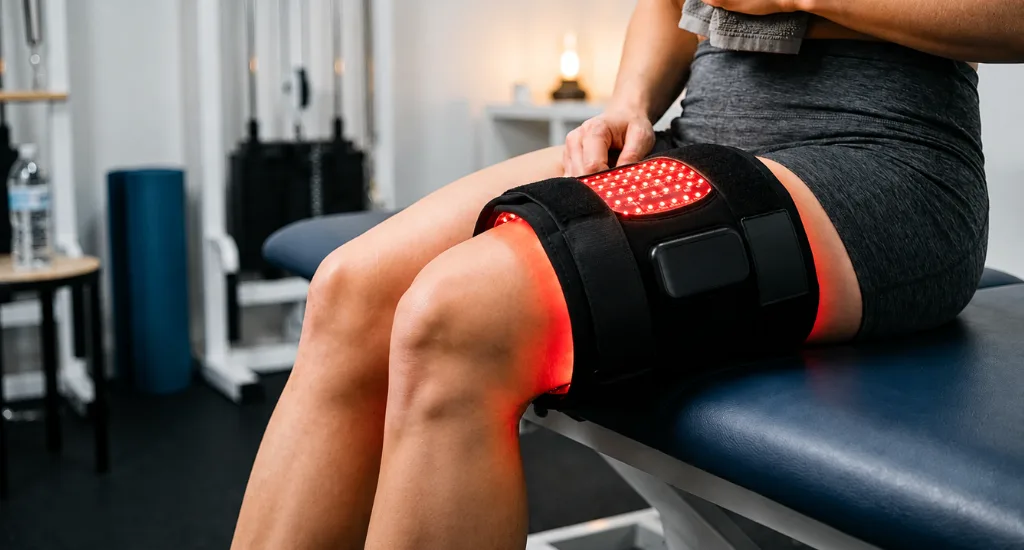
Choose these for the best red light therapy for muscle pain in one location, such as a knee, elbow, or strained hamstring. Kineon MOVE+ Pro, FlexBeam, and the dpl Joint Wrap are common picks. They are cheap, portable, and useless for whole-body work.
Panels for the Home Gym
Panels are the right answer for most home athletes. A mid-size dual-wavelength panel from Joovv, Mito Red Light, or Hooga covers a full muscle group at a workable distance and lasts years.
Full-Body Beds, Pods and Canopies
A red light therapy canopy for sports recovery treats the whole body in a single 10–20-minute session. That convenience is the entire argument. Unless you are treating daily, training at a professional level, or sharing the device across a team, a panel delivers the same dose to the tissue that matters for a fraction of the price.
6 Specs to Check Before You Buy
- FDA clearance: confirms a Class II device, not an unregistered import
- Verified irradiance at distance: the single most-hidden spec; if a brand will not publish it, skip them
- Dual wavelength: red and near-infrared, not red alone
- Treatment area: match it to the muscle groups you actually train
- EMF output: low-EMF construction matters for close-contact use
- Warranty and returns: 60-day returns and a 2–3 year warranty are the market standard
Safety, Side Effects and Common Mistakes
Red light therapy is low-risk for healthy adults. Reported side effects are limited to mild eye strain, temporary redness, and occasional headache.
Wear eye protection with high-output panels. Check with your doctor if you take photosensitizing medication, are pregnant, or are treating over a suspicious skin lesion. Dr. Dominic King of the Cleveland Clinic frames it as a complementary add-on, never as a reason to train through pain or to decline performance.
Four mistakes waste most sessions: standing too far from the panel, treating for two minutes, treating through clothing, and buying a device that never publishes its irradiance.
End Note
Red light therapy for athletes earns its place as a recovery adjunct, not a shortcut. The soreness and muscle-damage evidence is solid, the performance evidence is thinner, and the honest ceiling is a few percent. Get the wavelength and dose right, and you will feel the difference on back-to-back training days.
Keep the hierarchy straight. Sleep, nutrition, and sensible training load beat any device on the market. Once those are handled, a dual-wavelength panel used for 10–20 minutes after hard sessions is a reasonable next step. Track how you feel across a training block, then adjust.
Frequently Asked Questions
Does red light therapy actually work for muscle recovery?
Red light therapy does work for muscle recovery, with the strongest evidence for reduced soreness and lower creatine kinase in the 24–48 hours after training. Performance gains are less consistent.
How long should an athlete use red light therapy per session?
An athlete should use red light therapy for 10–20 minutes per treatment area after training, or 5–10 minutes per area before training. Longer sessions do not add benefit.
Is red light therapy better before or after a workout?
Red light therapy before a workout suits performance goals, and after a workout suits recovery goals. Pre-session light, 30–60 minutes out, is associated with more reps and lower lactate.
What wavelength is best for muscle recovery?
The best wavelength for muscle recovery is 850 nm near-infrared, because it penetrates 2–3 cm to reach muscle. Pair it with 660 nm red light for surface tissue and tendons.
Can you use red light therapy every day?
You can use red light therapy daily for short periods, but strength athletes should take a break every three weeks. Exceeding roughly 60–100 J/cm² in one session can inhibit rather than help cells.
Is a full-body red light bed or canopy worth it for athletes?
A full-body red light bed or canopy is worth it for teams, clinics, and daily users who value treating the whole body in a single session. Most individual athletes get the same tissue dose from a panel.