


Your inner elbow stings at impact. Your shoulder aches at the top of the backswing. Golfer’s elbow and shoulder pain often show up together, and both respond well to the right plan. Below, Dr. Jaime Mor, PT, DPT, ATC, and the team at Rehabletics in Cherry Hill explain why these two areas flare up, how to tell what is going on, and what actually fixes them. If the elbow is your main problem right now, you can also see how we approach inner elbow pain treatment for athletes.
Why Golfers Get Elbow and Shoulder Pain Together
The golf swing is a chain that starts at the ground and ends at the clubhead. When the hips and mid-back do not turn well, the shoulder and forearm absorb the extra load on every swing.
A single range session can mean hundreds of full swings, so most golf pain comes from overuse, not one bad shot. Research on golf injuries shows the shoulder accounts for up to 21 percent of injuries, and the elbow is the second most injured area in amateur golfers. Many golfers also notice that once they protect one sore arm, the other side starts to ache.
Golfer’s Elbow: What It Is and What It Feels Like
Golfer’s elbow, or medial epicondylitis, is irritation of the forearm tendons that attach to the bony bump on the inside of your elbow. Tennis elbow is the same type of problem on the outside of the elbow.
Golfer’s Elbow Symptoms
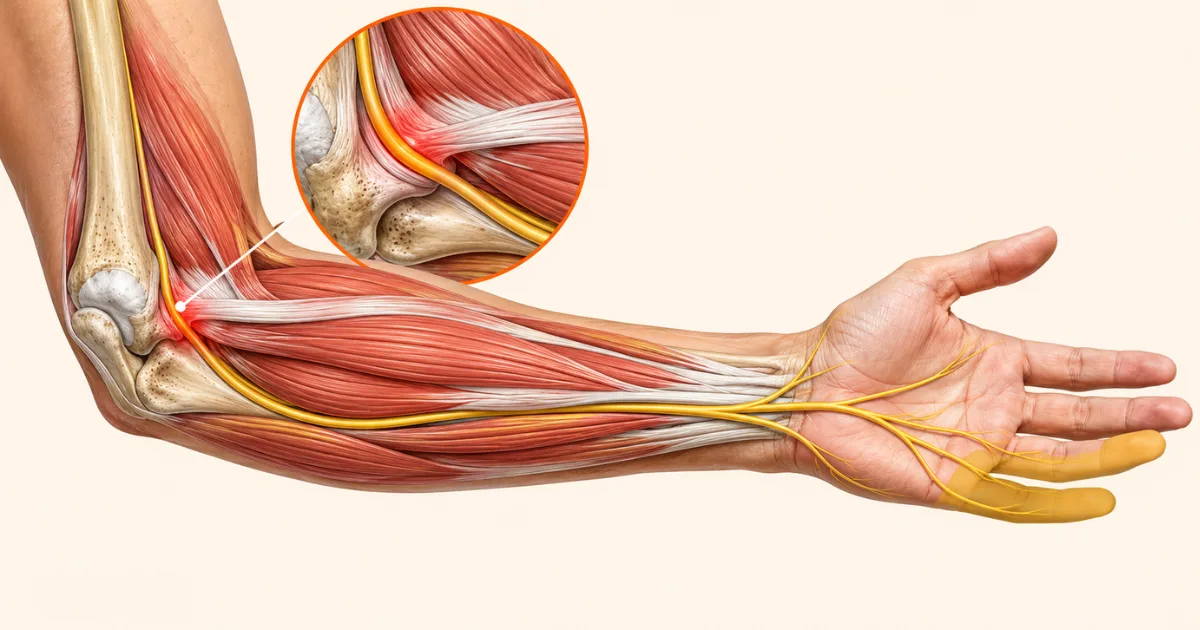
Common golfer’s elbow symptoms include:
- Pain on the inner elbow when you grip the club, carry your bag, or shake hands
- Inner elbow pain when bending and straightening the arm under load, such as lifting a pan
- Stiffness that is worse first thing in the morning
- A weaker grip than usual
- Tingling in the ring and little fingers, which suggests the nearby ulnar nerve is irritated
What Causes Golfer’s Elbow in Golfers
The forearm muscles work hard to control the club through impact. When that load exceeds what the tendon can handle, irritation builds over weeks.
In golfers, the usual triggers are heavy ground strikes and fat shots, a tight grip, grips that are too small, and a sudden jump in practice time. It often shows up in the trail arm (the right arm for right-handed golfers), although either arm can be affected.
Weak forearm and shoulder blade muscles and being over 40 also raise your risk. Golfer’s elbow is one of several tendon problems like tendinopathy that respond best to gradual, well-planned loading.
Golf Shoulder Pain: Lead Shoulder Versus Trail Shoulder
When you have a golf shoulder injury, which shoulder hurts and when in the swing it hurts usually point to the cause.
|
Shoulder |
When it hurts |
Likely structures involved |
| Lead (left for right-handed golfers) | Top of the backswing, end of the follow-through | AC joint, back of the shoulder, rotator cuff |
| Trail (right for right-handed golfers) | Downswing and the finish | Rotator cuff tendons, AC joint |
Finding the source is the first step in our approach to shoulder pain care for athletes.
Lead (Left) Shoulder Pain in the Backswing
The lead shoulder is the one golfers hurt most often. At the top of the backswing, your lead arm crosses your chest, which squeezes the AC joint and stretches the back of the shoulder. Left shoulder pain in the golf backswing is especially common when your mid-back is stiff. To finish the turn, you lift your arms higher instead, and that can pinch the rotator cuff under the bone above it. You can learn more about how shoulder impingement develops, including why posture matters.
Trail (Right) Shoulder Pain From Golf
Right shoulder pain from golf usually comes from two moments. In the downswing, the trail shoulder works too hard when the arms start the move before the hips. At the finish, the trail arm crosses the body and loads the AC joint.
Golf Shoulder Injury Symptoms
Watch for these signs:
- Pain at the top of the backswing or at the finish
- Pain when reaching overhead
- Aching at night or when lying on that side
- Clicking or catching in the joint
- Weakness or a shorter, restricted turn
Sudden weakness after one swing, or numbness running down the arm, needs a prompt evaluation.
How Long Golfer’s Elbow Takes to Heal
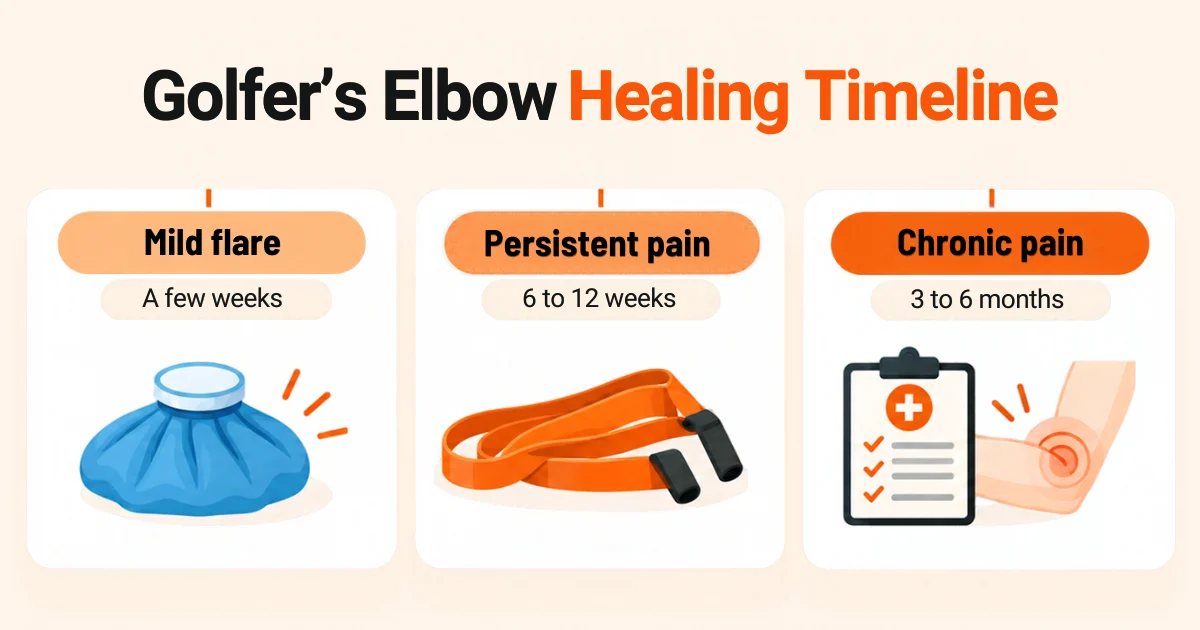
Most mild cases of golfer’s elbow improve within a few weeks once you change your load and start the right exercises. Established cases commonly take 3 to 6 months, and surgery is rarely needed.
|
Stage |
Typical golfer’s elbow recovery time |
What usually helps |
| Mild flare | A few weeks | Less practice, ice, grip changes |
| Persistent pain | 6 to 12 weeks | Physical therapy and tendon loading |
| Chronic pain | 3 to 6 months | Guided rehab plus advanced options |
A month off with no exercise often fails, because tendons heal through gradual loading, not complete rest.
Treatment for Golfer’s Elbow and Golf Shoulder Pain
First Steps for Quick Relief
For fast golf shoulder pain relief and a calmer elbow, cut back on range sessions and full swings while keeping your short game if it is pain-free. Ice for 15 to 20 minutes after you play. A counterforce strap can ease elbow pain, and a push cart takes weight off a sore shoulder. A strap eases symptoms but does not fix the cause.
How Physical Therapy Treats Both
Effective golfer’s elbow treatment looks beyond the elbow. At Rehabletics, we assess your elbow, shoulder, mid-back, hips, and swing. Your plan may include hands-on therapy, progressive tendon loading, rotator cuff and shoulder blade strength work, and mid-back mobility drills.
Golf shoulder pain treatment follows the same idea: calm the tissue, then build strength and rotation. For tendons that have not responded to exercise alone, we may add shockwave therapy for stubborn tendons to help restart healing.
We may also suggest short-term swing changes, such as a shorter backswing and lighter grip pressure.
Exercises and Stretches for Golfer’s Elbow and Shoulder Pain
Mild discomfort, up to about 3 out of 10, is acceptable during these exercises. Sharp pain means stop.
Exercises for Golfer’s Elbow
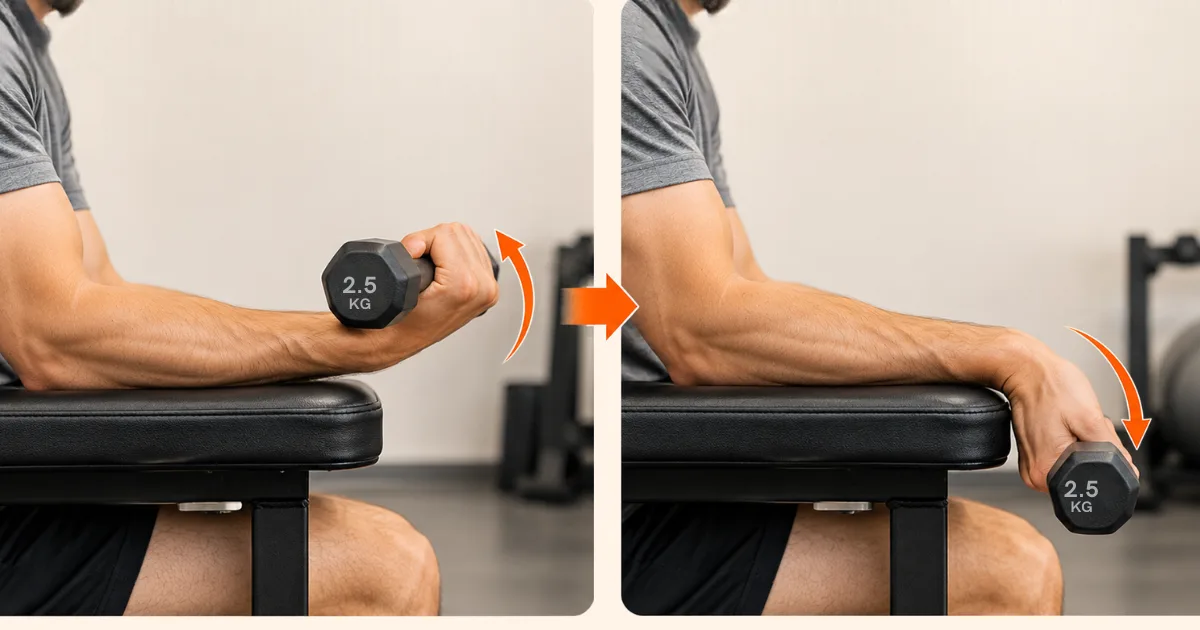
These golfer’s elbow exercises build tendon capacity:
- Eccentric wrist curls: Hold a light dumbbell palm up and lower it slowly for 3 to 5 seconds.
- Grip squeezes: Squeeze a soft ball for 5 seconds and repeat 10 times.
- Forearm rotations: Hold a hammer and slowly turn your palm up and down.
- Wrist flexor stretch: Straighten your arm, palm up, and gently pull your fingers back.
Exercises for Golf Shoulder Pain
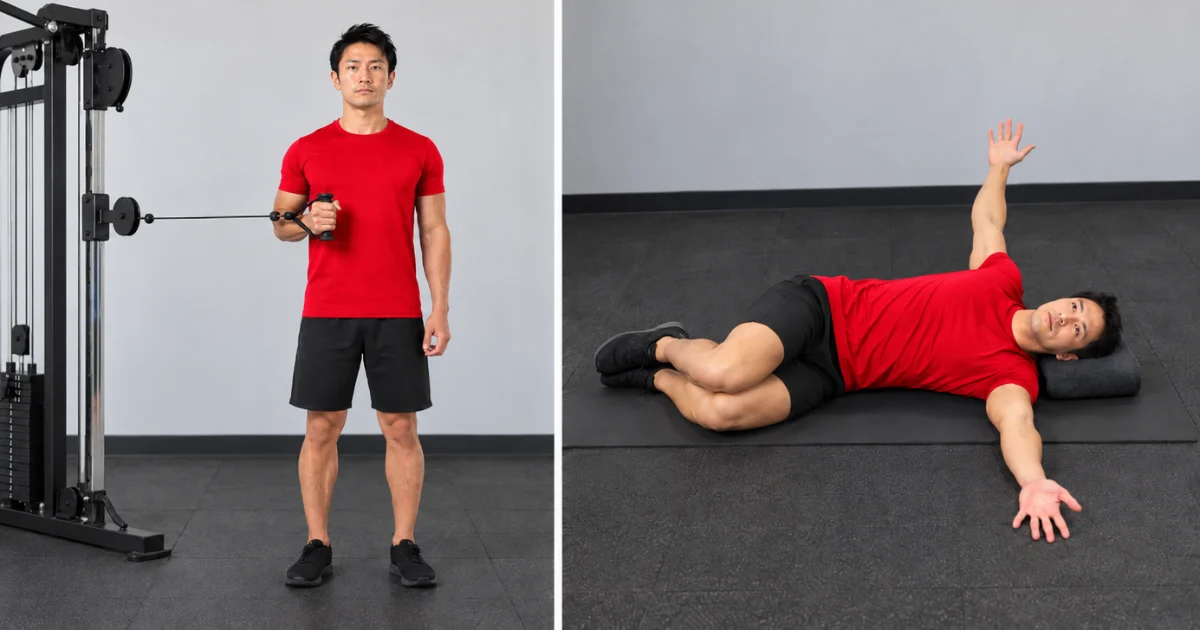
Start with these golf shoulder pain exercises two to three times a week:
- Band external rotation: Keep your elbow at your side and rotate your forearm outward.
- Band rows: Pull your shoulder blades back and down.
- Scapular push-ups: Keep your arms straight and let your shoulder blades move.
- Side-lying open book: Rotate your top arm open to improve mid-back turn.
For more shoulder rehab detail, see our guide to physical therapy for shoulder pain.
Stretches for the Elbow and Shoulder
Good golf shoulder pain stretches include a gentle cross-body stretch, a doorway chest stretch, and a seated thoracic rotation. Hold each one for 20 to 30 seconds without pain.
How to Prevent Golfer’s Shoulder and Elbow Pain
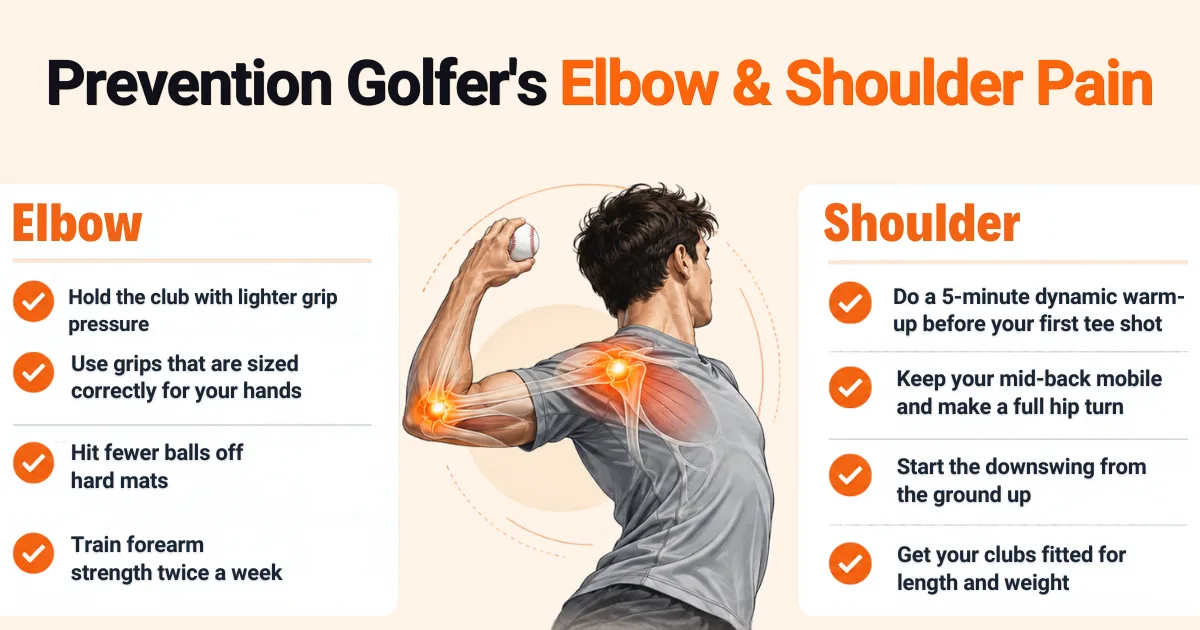
How to avoid elbow pain while playing golf:
- Hold the club with lighter grip pressure.
- Use grips that are sized correctly for your hands.
- Hit fewer balls off hard mats.
- Train forearm strength twice a week.
How to avoid shoulder pain while playing golf:
- Do a 5-minute dynamic warm-up before your first tee shot.
- Keep your mid-back mobile and make a full hip turn.
- Start the downswing from the ground up.
- Get your clubs fitted for length and weight.
For both joints, increase practice time gradually, plan rest days, and take a lesson to fix swing faults. Pain that keeps returning usually has an underlying cause, which is often why injuries keep coming back for active adults.
Get Back to Pain-Free Golf in Cherry Hill
At Rehabletics, 5 Esterbrook Lane in Cherry Hill, Dr. Jaime Mor and our team evaluate your elbow, shoulder, and swing in one-on-one sessions and build a plan to get you back on the course. Learn more about sports injury treatment at Rehabletics for golfers across South Jersey. When you are ready, book a call with our team.