



It starts small. A pinch when you reach for the seatbelt. A dull ache after the bench press that is still there the next morning. Then one night you roll onto that side and wake up because your shoulder hurts. If that sounds familiar, you are not alone, and you probably have more options than you think.
Quick answer: Physical therapy is a first-line treatment for most shoulder pain. A physical therapist combines hands-on care, mobility work and progressive strengthening to calm pain, restore motion and fix the weakness behind it. Most people notice clear improvement within 4 to 12 weeks, often without injections or surgery.
At Rehabletics, our shoulder pain treatment in Cherry Hill follows exactly that approach. This guide explains what physical therapy for shoulder pain involves, which conditions it treats, the exercises that help (and the ones that do not), how long recovery usually takes and when you should get checked.
Can Physical Therapy Help With Shoulder Pain?
Yes. For most shoulder problems that are not caused by a fracture or a major tear, physical therapy is the recommended starting point. Clinical guidelines list exercise-based rehab as first-line care for rotator cuff pain, impingement and frozen shoulder, and research on non-traumatic shoulder pain shows that structured rehab can produce results similar to surgery for many people.

That matters because shoulder pain is common. Studies estimate that it affects roughly 18 to 26 percent of adults at any given time, and it is one of the most frequent reasons people visit a doctor for joint or muscle pain, behind only back and knee pain.
Physical therapy works because it treats the cause rather than just the symptom. Medication can quiet pain for a few hours. An injection can calm inflammation for a few weeks. Neither one rebuilds a weak rotator cuff, fixes how your shoulder blade moves, or changes the training habits that irritated the joint in the first place. A good rehab plan does all three.
PT tends to help most if you have:
- Pain from overuse, such as lifting, throwing, swimming, or overhead work
- Stiffness or lost range of motion
- Weakness after an injury or a long layoff
- A surgery coming up, or a surgery already behind you
Why the Shoulder Gets Hurt So Easily
Your shoulder is the most mobile joint in your body. The ball at the top of your upper arm (the humerus) sits in a shallow socket on your shoulder blade (the scapula), a bit like a golf ball resting on a tee. The collarbone (clavicle) connects the whole unit to your trunk.
Because the socket is so shallow, the joint relies on muscles to hold it steady. The most important are the four rotator cuff muscles, which keep the ball centered as you move. Your shoulder blade acts as the moving base underneath. When the rotator cuff gets tired or weak, or the shoulder blade stops moving well, the joint loses control and tissues start to get pinched or overloaded. Your risk climbs after age 40, with diabetes and with repeated overhead activity.
Shoulder Conditions Physical Therapy Treats
Most shoulder pain comes from a short list of problems. Knowing which one you have shapes the whole plan.

| Condition | What it often feels like | What PT focuses on |
| Shoulder impingement | Pain lifting the arm to shoulder height or above | Rotator cuff strength, shoulder blade control, posture |
| Rotator cuff tendinopathy or partial tear | Night pain, ache on the outside of the arm, weakness | Progressive tendon loading, strength, motion |
| Bicep tendonitis | Pain at the front of the shoulder, worse with lifting | Load management, gradual strengthening |
| Sprain or instability | Pain after a fall or hit, feeling of looseness | Stability, strength, return to sport |
| Frozen shoulder | Gradual, severe stiffness in every direction | Gentle mobility, joint mobilization |
| Bursitis or arthritis | Aching, stiffness, pain with use | Motion, strength, activity changes |
| Neck-related shoulder pain | Pain spreading from the neck, possible tingling | Neck treatment, posture, nerve mobility |
Shoulder Impingement
Shoulder impingement happens when the rotator cuff tendons and the bursa above them get irritated as you raise your arm. The classic sign is a “painful arc,” where pain shows up somewhere between shoulder height and overhead. Weak rotator cuff muscles, a rounded posture, and poor shoulder blade movement usually play a part. For a deeper look at causes and specific drills, see our complete shoulder impingement guide.
Rotator Cuff Tendinopathy and Tears
Rotator cuff tendinopathy is an overloaded, irritated tendon. It often aches at night and when you reach out to the side. Many partial tears, and even some full-thickness tears in older adults, respond well to physical therapy because strengthening the muscles around the tear restores function. Our tendinopathy treatment page explains how we load tendons safely so they adapt and get stronger.
Bicep Tendonitis
The long head of the biceps tendon runs through a groove at the front of the shoulder. When it gets irritated, you feel pain right at the front of the joint, especially when lifting, curling or reaching overhead. A common mistake is stretching it hard. Many people with bicep tendonitis find that aggressive stretching makes it worse. The tendon usually needs a short break from heavy loading followed by gradual, pain-free strengthening.
Shoulder Sprains, Instability and Sports Injuries
Falls, tackles and collisions can sprain the AC joint (where the collarbone meets the shoulder blade), stretch the joint capsule or injure the labrum, the ring of cartilage that deepens the socket. Physical therapy for a shoulder sprain or a past dislocation focuses on strength and control so the joint stays stable under speed and contact. Athletes recovering from these injuries can learn more about our sports injury rehab approach.
Frozen Shoulder, Bursitis and Arthritis
Frozen shoulder (adhesive capsulitis) causes the joint capsule to tighten, so motion is lost in every direction. It moves through painful, stiff and thawing stages over many months. Bursitis and arthritis tend to cause aching and stiffness that build with use. In all three, gentle, consistent mobility work and strength training help you keep function while the joint settles down.
Neck and Shoulder Pain That Travels Together
Not all shoulder pain starts in the shoulder. An irritated joint or nerve in the neck can send pain to the top of the shoulder, the shoulder blade or down the arm, sometimes with tingling. That is why a thorough physical therapist always checks your neck. If your pain changes when you turn or tilt your head, neck pain physical therapy may need to be part of your plan.
What Does a Physical Therapist Do for Shoulder Pain at the First Visit?
Your first session is mostly about finding the real reason your shoulder hurts. A typical evaluation includes:
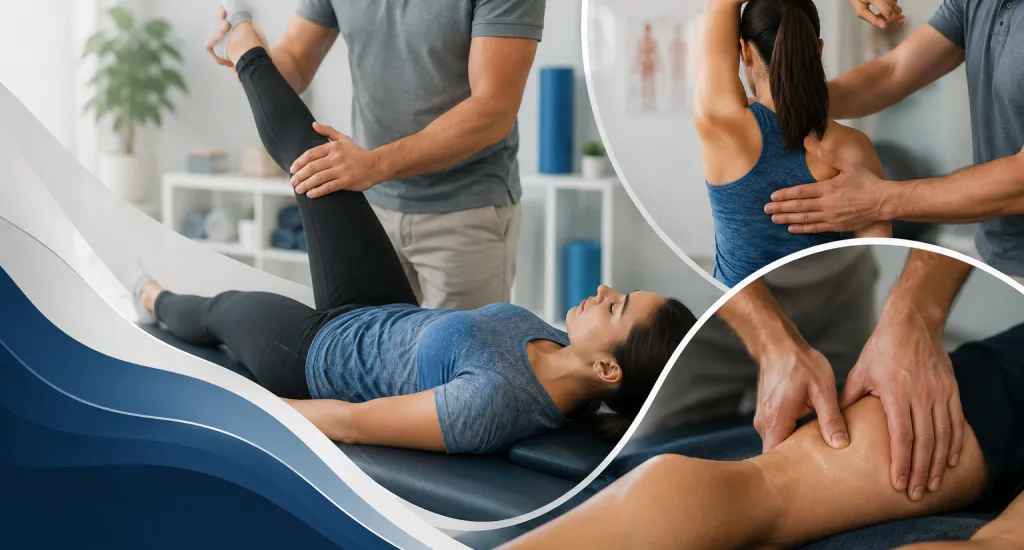
- History and goals: when the pain started, what makes it worse and what you want to get back to
- Range of motion: how far your arm moves on its own and with help
- Strength testing: each rotator cuff and shoulder blade muscle, side by side
- Special tests: specific movements that point toward impingement, a tendon problem, instability or a labral issue
- Shoulder blade movement: how your scapula moves as you lift and lower your arm
- Neck screen: to rule out the neck in or out
- Plan and home program: your first exercises, plus clear guidance on what to change in daily life
You do not need to wait for a doctor’s note to start. New Jersey allows direct access physical therapy in Cherry hil, so you can book an evaluation yourself. If you want a step-by-step picture of the visit, here is what happens at your first appointment.
How Do You Know if Shoulder Pain Is Muscle or Joint?
Muscle pain usually feels like an ache or a tender spot that gets worse with use and eases with rest. You can often press on it and find the sore area. Joint pain tends to feel deeper inside the shoulder. It may come with catching, clicking, a feeling of instability or sharp pain at the end of a movement. Stiffness that limits motion in several directions also points toward the joint. A physical therapist can confirm which one you are dealing with in a single visit.
What Kind of Physical Therapy Is Used for Shoulders?
The best therapy for shoulder pain is active exercise supported by hands-on care. Passive treatments help you feel better sooner, while exercise makes the results last. Here is what a complete shoulder treatment plan in physical therapy usually includes.
Manual Therapy and Joint Mobilization
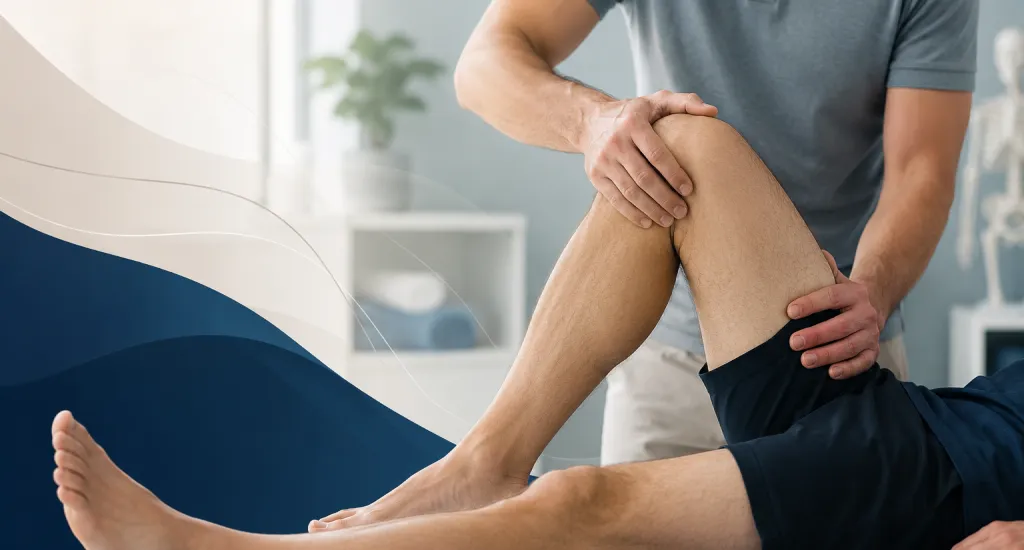
Your therapist uses their hands to glide the shoulder joint, loosen a tight back of the shoulder capsule and free up the shoulder blade and upper back. These techniques reduce pain and restore motion, so exercise feels easier. At Rehabletics, hands-on manual therapy is paired with movement right away, so you keep the motion you gain.
Massage and Soft Tissue Work for Shoulder Impingement
Massage for shoulder impingement can ease guarded muscles such as the upper trapezius, pec minor and the back of the rotator cuff. Cross-friction massage across an irritated tendon and myofascial release often bring quick relief. Some patients also do well with instrument-assisted soft tissue work, which uses a smooth tool to treat tight tissue. Soft tissue work supports exercise. It does not replace it.
Dry Needling for Tight, Guarded Muscles
When muscles around the shoulder lock up to protect the joint, trigger points can keep pain going long after the original injury. A licensed therapist can use dry needling for shoulder trigger points to release those knots so you can move and strengthen more comfortably.
Therapeutic Exercise: Mobility, Rotator Cuff and Scapular Strength

Exercise is the core of every plan. It starts with pain-free motion, moves to isometrics (holding against resistance without moving) and then builds to bands, weights and sport-specific work. If you are wondering what kind of physical therapy helps shoulder tendonitis, this is the answer: steady, progressive tendon loading. Tendons respond to the right amount of load and slowly become stronger and less sensitive.
Modalities: Ice, Heat, Taping and Shockwave
Ice helps after a flare-up or a hard session. Heat relaxes stiff muscles before exercise. Kinesiology taping can support the shoulder blade and give helpful feedback during movement. For stubborn tendon pain that has lasted months, shockwave therapy for stubborn tendon pain uses sound waves to stimulate healing in the tissue.
Blood Flow Restriction Training
When heavy lifting still hurts, blood flow restriction training lets you build real strength with light weights. A cuff on the upper arm limits blood flow during exercise, which makes light loads work the muscles much harder. It is especially useful early in rehab and after surgery.
Education, Posture and Activity Changes
Small changes add up. Your therapist will help you adjust training loads, sleeping positions, your desk setup and lifting technique so the shoulder is not irritated again every day.
| Treatment | Best for | Role in recovery |
| Therapeutic exercise | Every shoulder condition | Active, long-term fix |
| Manual therapy | Stiffness, pain, limited motion | Passive support |
| Soft tissue work and massage | Guarded, tight muscles | Passive support |
| Dry needling | Trigger points, muscle tension | Passive support |
| Shockwave | Long-standing tendon pain | Passive support |
| Blood flow restriction | Weakness when heavy loads hurt | Active strength builder |
| Education and activity changes | Preventing flare-ups | Active, long-term fix |
The 4 Phases of Shoulder Pain Rehabilitation
Shoulder pain rehabilitation moves through stages. You advance when you meet the goals of each phase, not just because a certain number of weeks has passed.
- Calm the pain and protect the tissue. You reduce irritating activities without stopping all movement. Pain-free motion, ice or heat, gentle manual therapy and light isometrics keep the shoulder working while it settles.
- Restore range of motion. Pendulums, assisted arm raises, wall slides and joint mobilization bring back the motion you lost. The goal is near-full, comfortable motion.
- Build strength and stability. Band work, rows, rotator cuff exercises and shoulder blade training rebuild control. Blood flow restriction can speed up strength gains here.
- Return to sport, work and lifting. You progress to overhead loading, faster movements, plyometrics and sport-specific drills. Throwers follow a structured throwing program, and our baseball injury rehab team builds these for pitchers and position players.
How you know you are ready to move on:
- Pain stays at 3 out of 10 or lower during and after exercise
- Motion is close to your other shoulder
- Strength tests are within about 10 percent of the healthy side before full return to sport
Skipping phase 4 is one of the main reasons shoulder pain comes back. Feeling better is not the same as being ready for the demands of your sport. A swimmer needs endurance through thousands of strokes, a lifter needs control under a heavy overhead load and a pitcher needs the shoulder to handle high speeds again and again. Phase 4 trains for those exact demands, which is why we test strength and movement before you go back to full competition.
Physical Therapy Exercises for Shoulder Pain
The exercises below are common in shoulder rehab. Use them as a guide, and ask a physical therapist which ones fit your condition before you start. The wrong exercise at the wrong stage can slow recovery.
Mobility Exercises
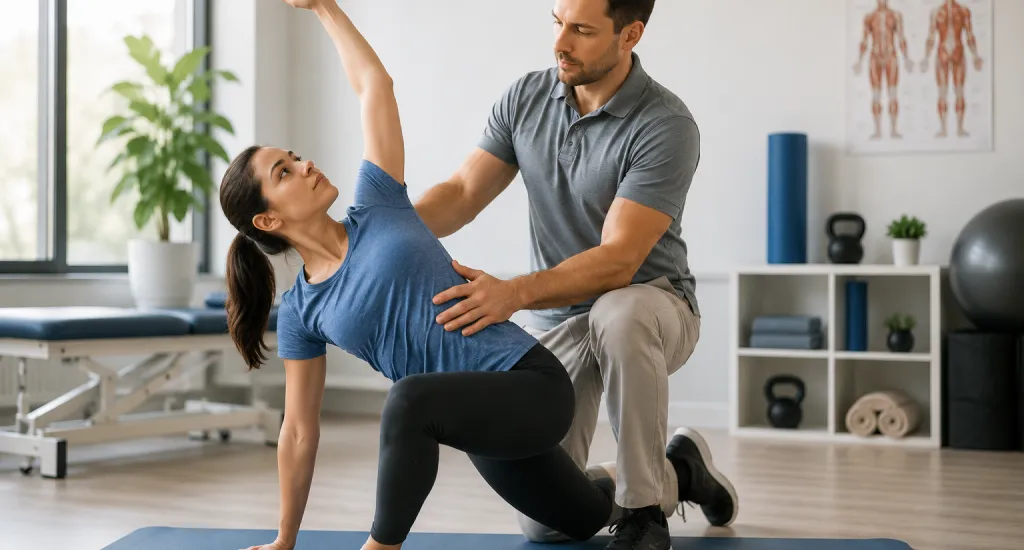
- Pendulum: Lean forward with your good hand on a table and let the sore arm hang. Gently swing it in small circles. Do 2 sets of 10 circles in each direction.
- Cross-body stretch: Pull your arm across your chest with the other hand until you feel a gentle stretch in the back of the shoulder. Hold for 30 seconds, 3 times.
- Doorway chest stretch: Place your forearms on a door frame and step forward slowly. Hold for 30 seconds, 3 times.
- Wall slides: Slide your forearms up a wall while keeping your shoulders down and away from your ears. Do 2 sets of 10.
Strengthening Exercises
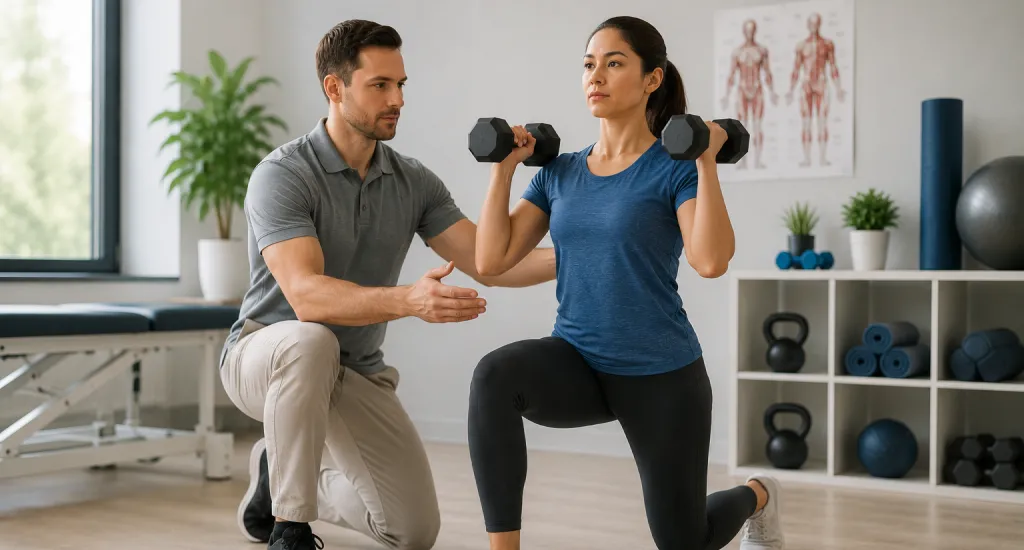
- Isometrics: Press your hand into a wall forward, outward and inward at about 75 to 80 percent effort. Hold each for 5 to 10 seconds, 5 reps, 2 sets.
- Band external rotation: Keep your elbow at your side, bent to 90 degrees, and rotate your forearm outward against a band. Do 2 to 3 sets of 10 to 15.
- Band internal rotation: Use the same position and rotate inward. Do 2 to 3 sets of 10 to 15.
- Standing rows: Pull a band toward your ribs and squeeze your shoulder blades together. Do 3 sets of 10.
- Shoulder blade squeezes: Pinch your shoulder blades back and down and hold for 5 seconds. Do 2 sets of 10 to 15 daily.
Aim for strength work 3 to 4 times a week and mobility work most days.
The Pain Rules for Shoulder Exercise
Some discomfort is acceptable. Use a 0 to 10 pain scale:
- 0 to 3: Fine to continue
- 4 to 5: Reduce the weight, range, or reps
- 6 or higher: Stop that exercise and check with your therapist
Your shoulder should feel no worse the next morning than it did before the session. Consistency matters more than intensity, so a little work most days beats one hard session a week.
Shoulder Pain Exercises to Avoid
While your shoulder is irritated, avoid or modify:
- Upright rows
- Behind-the-neck presses and pulldowns
- Deep bench dips
- Aggressive biceps or shoulder stretching
- Any lift that causes sharp pain
Pitchers, quarterbacks and volleyball players often need throwing-specific changes too. Our guide on why your shoulder hurts when throwing covers mechanics and simple fixes.
How Long Is Physical Therapy for Shoulder Pain?
Most people need 4 to 12 weeks of physical therapy for shoulder pain. Each session usually lasts 45 to 60 minutes. Visits often start at 1 to 2 times a week and taper as you get stronger, while your home program continues most days. The table below shows typical ranges.
| Condition | Typical PT length |
| Mild strain or sprain | 2 to 6 weeks |
| Tendonitis or bicep tendonitis | 4 to 8 weeks |
| Shoulder impingement | 6 to 12 weeks |
| Partial rotator cuff tear | 3 to 6 months |
| Frozen shoulder | Several months or longer |
| After rotator cuff repair surgery | 4 to 6 months or more |
These are averages. Your own timeline depends on how irritated the tissue is, how long you have had the problem and what you need your shoulder to do.
How Many Weeks of Physical Therapy for Shoulder Impingement?
Shoulder impingement usually needs 6 to 12 weeks of consistent physical therapy. Many people feel less pain within the first 2 to 4 weeks as irritation settles and motion improves. The remaining weeks rebuild rotator cuff and shoulder blade strength so the problem does not return. If you see no real progress after about 6 weeks, your plan should be reviewed and imaging may be considered.
What Speeds Up or Slows Down Recovery
Two people with the same diagnosis can finish rehab weeks apart. The difference usually comes down to a few habits and health factors, and most of them are within your control.
Recovery tends to go faster when you:
- Do your home exercises consistently
- Sleep well and manage training load
- Start treatment early instead of waiting months
- Help set your rehab goals, which research links to better results
Recovery tends to be slower with:
- Pain that has lasted many months
- Diabetes or other health conditions
- Age over 40
- High-demand overhead sports or jobs
Physical Therapy Versus Injections, Medication and Surgery
Each option has a place. The question is which one fixes your problem with the least risk.
| Option | What it does | Best for | Limits |
| Physical therapy | Restores motion, strength and control | Most shoulder pain, before and after surgery | Takes consistent effort over weeks |
| Medication (NSAIDs) | Short-term pain relief | Flare-ups | Does not fix weakness or movement problems |
| Steroid injection | Calms inflammation for weeks | Severe pain blocking rehab | Temporary; repeated shots may affect tendons |
| Surgery | Repairs damaged structures | Large acute tears, repeated dislocations | Long recovery; still needs rehab |
A doctor’s visit, imaging or a surgical consult makes sense when you have red flags, see no progress after 4 to 6 weeks of good rehab, have a large tear from a sudden injury, keep dislocating your shoulder, or have tried 3 or more months of conservative care without meaningful change.
If surgery is the right call, physical therapy is still part of the process. Building strength before the operation and following a guided plan afterward both improve your result. Our post-surgical rehabilitation program takes you from the sling stage back to full activity.
When to See a Shoulder Pain Physical Therapist
It is time to book an evaluation if:
- Your pain has lasted more than 1 to 2 weeks
- Shoulder pain wakes you at night
- Your arm feels weak or you have lost motion
- Pain is limiting your workouts, sport or job
Get medical care first, and go to the emergency room when needed, if shoulder pain comes with chest pain, shortness of breath, fever, a visible deformity after a fall, sudden inability to lift your arm, or numbness and weakness down the arm. Not sure whether your situation calls for PT? Here are the signs it is time to see a sports physical therapist.
Do’s and Don’ts for Shoulder Pain
Do:
- Keep the shoulder moving gently within a comfortable range
- Use ice after activity and heat for stiffness
- Sleep on your back or the other side with a pillow supporting the sore arm
- Get evaluated if the pain is not improving
Don’t:
- Keep the arm still in a sling for weeks without guidance
- Push through sharp pain
- Stretch aggressively into pain
- Return to heavy overhead lifting before you have rebuilt strength
Sports Physical Therapy for Shoulder Pain in Cherry Hill, NJ
At Rehabletics, every shoulder patient works one-on-one with a licensed physical therapist for the entire session. Our team is led by Dr. Jaime Mor, PT, DPT, ATC, a sports physical therapy contractor for the Philadelphia Flyers and Philadelphia Eagles. That pro-level experience shapes how we treat every shoulder, whether you are a pitcher, a CrossFit athlete, a swimmer or someone who just wants to sleep through the night again.
Your plan can draw on more than 20 treatment options under one roof, including manual therapy, dry needling, shockwave and blood flow restriction. We are an out-of-network clinic, and you can learn how out-of-network physical therapy works and how to use your plan’s benefits. You can also hear directly from athletes in our patient testimonial videos.
Our Cherry Hill sports injury clinic sits at 5 Esterbrook Lane and serves athletes and active adults across South Jersey. We are open Monday to Friday from 7:00 AM to 7:00 PM, Saturday from 8:00 AM to 12:00 PM and Sunday from 9:00 AM to 12:30 PM. Call 609-354-7987 or book your free consultation to find out what is behind your shoulder pain and start your plan.