



You reach for a bag in the overhead bin and your shoulder catches. You roll onto that side at 2 a.m. and wake up. Your arm still works, but every overhead lift comes with a warning now.
Shoulder impingement syndrome therapy is the first-line treatment for that pattern, and it resolves most cases without surgery. Shoulder pain affects up to 30% of adults, and Harvard Health reports impingement is the most common cause. Rehab works when it follows a plan. It stalls when it is a random list of band exercises.
This guide covers the exam tests, the four-phase rehabilitation protocol, exercises with real reps and sets, an honest recovery timeline, and what to do when therapy isn’t working. Read on.
What Is Shoulder Impingement Syndrome?
Shoulder impingement syndrome is compression of the rotator cuff tendons and the bursa inside the subacromial space, the narrow gap between the top of your arm bone and the acromion. Every time you lift your arm, that gap narrows. When the tissue inside is swollen, or the space is tight, the tendon gets pinched.
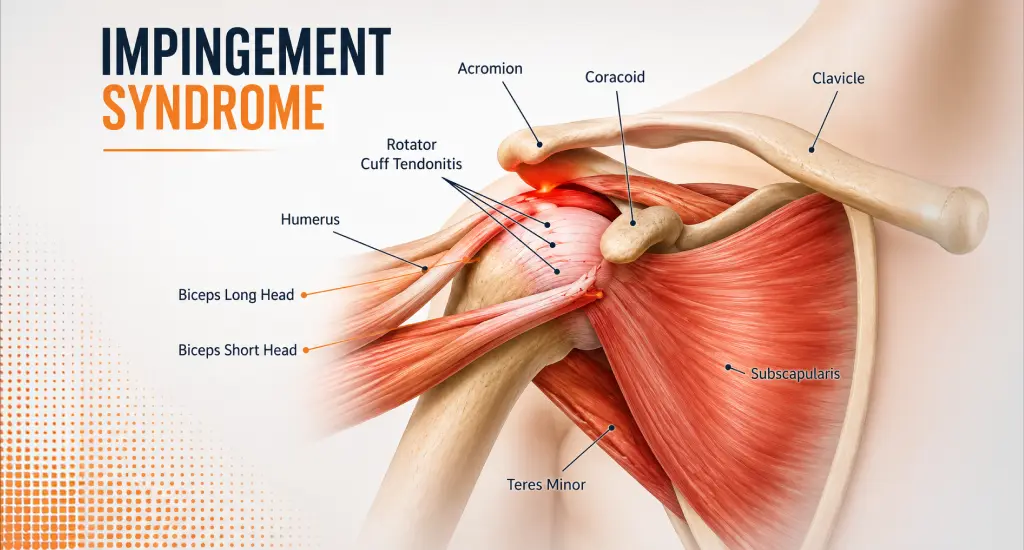
The condition goes by several names. Subacromial impingement describes the location. Rotator cuff tendinitis describes the irritated tendon. Subacromial bursitis describes the inflamed cushion. Shoulder compression syndrome is the plain-language version. They point to one problem.
The supraspinatus tendon takes the most pressure, which is why pain shows up at the front and outside of the shoulder rather than deep inside the joint.
External vs Internal Impingement
External impingement happens under the acromion and splits into two drivers. Primary impingement is structural: a bone spur, a hooked acromion, arthritic change. Secondary impingement is functional: the shoulder blade does not rotate properly, so the space closes on its own.
Internal impingement is different. The tendon pinches between the humeral head and the rim of the socket during extreme external rotation, the late cocking position of a throw. Physiopedia links it to a loss of internal rotation called GIRD, common in baseball, tennis, volleyball, and swimming.
The Neer Stages of Impingement
Charles Neer described three stages of subacromial impingement, and the stage changes what rehab must accomplish.
|
Stage |
Typical age |
What the tissue is doing |
| Stage 1 | Under 25 | Reversible swelling and bleeding in the tendon |
| Stage 2 | 25 to 40 | Fibrosis and thickening of the supraspinatus tendon and bursa |
| Stage 3 | Over 40 | Bone spur formation with partial or complete rotator cuff tears |
A Stage 1 shoulder calms quickly. A Stage 3 shoulder needs more time and a closer look at the cuff.
Signs You’re Dealing With Impingement, Not Something Else
The painful arc of the shoulder is the signature sign. Pain appears as you raise the arm between roughly 60 and 120 degrees, then eases above that range. That window is where the tendon passes closest to the acromion.
Other symptoms cluster with it:
- Overhead pain when reaching, throwing, or lifting above shoulder height
- Night pain that wakes you, especially lying on the affected side
- Pain reaching behind your back to fasten a seatbelt or a bra strap
- Weakness lifting anything heavy above shoulder level
- Clicking or popping when you rotate the arm
Shoulder clicking when rotating is usually mechanical rather than dangerous, and often comes from thickened bursal tissue moving under the acromion. Clicking with pain and weakness deserves an exam. Clicking alone usually does not.
Impingement is not the only explanation. A rotator cuff tear can make weakness seem out of proportion to pain. Frozen shoulder limits motion in every direction, even when someone else moves your arm. AC joint trouble hurts on top. Neck problems send pain past the elbow with tingling.
Shoulder Pain Exam Tests Your Therapist Will Use
No single shoulder test diagnoses impingement on its own. Clinicians use a cluster. The accuracy figures below come from diagnostic research summarized by Physiopedia.
| Test | How it’s performed | Positive sign | Sensitivity | Specificity |
| Painful Arc | Arm raised to full elevation, then lowered | Pain between 60 and 120 degrees | 75% | 67% |
| Empty Can (Jobe) | Arm at 90 degrees, thumb down, downward pressure applied | Pain or inability to hold position | 50% | 87% |
| External Rotation Resistance | Elbow at 90 degrees at your side, inward force resisted | Pain or weakness | 56% | 87% |
| Neer | Scapula stabilized, arm flexed forward overhead | Pain with flexion | 81% | 54% |
| Hawkins-Kennedy | Shoulder and elbow at 90 degrees, arm rotated inward | Pain with internal rotation | 63% | 62% |
The combination matters more than any single result. Two or more positives among painful arc, empty can, and external rotation resistance point strongly toward subacromial impingement. When painful arc and external rotation resistance are both negative, impingement becomes unlikely.
Do You Need an MRI for Shoulder Impingement?
You usually do not need an MRI to start treatment for shoulder impingement. It is a clinical diagnosis, and imaging rarely changes the first six weeks of care.
Imaging earns its place in four situations: trauma caused the pain, you cannot lift the arm at all, weakness is far worse than the pain, or six to eight weeks of honest rehab changed nothing. X-ray shows bone spurs and acromion shape. MRI shows tears, fluid, and bursal thickening.
Why Physical Therapy Is the First-Line Treatment
Physical therapy is first-line because it treats the cause of the compression, not the symptom. Rest quiets a shoulder. It does not restore the scapular control that keeps the space open.
The Optimal Management of Shoulder Impingement Syndrome review supports three points:
- Manual therapy plus exercise beats exercise alone. Patients receiving both reported less pain at three weeks than patients doing exercises only.
- Steroid injections used in isolation show minimal effectiveness, and the same review notes they may contribute to tendon atrophy.
- Pain shuts strength down. A painful shoulder shows a 32% drop in external rotation force and a 23% drop in muscle activation.
That last figure explains the most common rehab failure. Loading a shoulder that still hurts recruits the wrong muscles. Calm the pain first, then strengthen. Skip that order and the exercises feel useless because they are.
The Shoulder Impingement Rehabilitation Protocol: 4 Phases
Shoulder impingement rehab runs in four phases, each with its own goal and exit criteria. You progress when you meet the criteria, not when the calendar says so.
Phase 1: Calm It Down (Weeks 0 to 2)
The goal is pain control and protected motion. Stop the movements that reproduce the painful arc: overhead pressing, heavy reaching, sleeping on that side.
Work stays gentle. Pendulum swings restore motion without muscle demand. Submaximal isometric holds keep the cuff active without entering the painful range. Scapular setting teaches the shoulder blade to sit back and down. Ice after aggravating activity, and treat posture cues as part of treatment.
Move on when: night pain is easing, and you can lift the arm to shoulder height without a sharp catch.
Phase 2: Restore Motion and Scapular Control (Weeks 2 to 6)
The goal is full range and a shoulder blade that moves properly. Most therapy for shoulder impingement syndrome happens here.
Band external and internal rotation build the cuff at a safe angle. Serratus punches and lower trap work at the wall restore upward rotation of the scapula. Doorway pec stretching opens the chest that has been pulling the shoulder forward. Throwers add the sleeper stretch to reverse GIRD.
Move on when: you have full pain-free range below shoulder height and can hold a rotation band for 15 controlled reps.
Phase 3: Load the Rotator Cuff (Weeks 6 to 12)
The goal is real strength through full range. Light bands stop being enough here, and staying on them is why some shoulders plateau.
Rotator cuff exercises progress in load. Rows, band pull-aparts, and Cuban rotations build the back of the shoulder. Overhead work returns gradually, starting in the scapular plane. Athletes add light plyometrics late in this phase.
Move on when: strength is symmetrical side to side and overhead movement is pain-free under load.
Phase 4: Return to Sport and Overhead Work (Week 12 and Beyond)
The goal is confidence under sport-specific demand. Throwers follow an interval throwing program. Swimmers rebuild volume in steps. Lifters reintroduce pressing from the bottom up.
Good return-to-sport decisions use measurement, not feel. Strength testing and force plate data show whether the shoulder is ready or just quiet.
Best Exercises for Shoulder Pain and Weakness
These eight exercises cover Phase 1 through Phase 3. Nothing here should reproduce sharp pain.
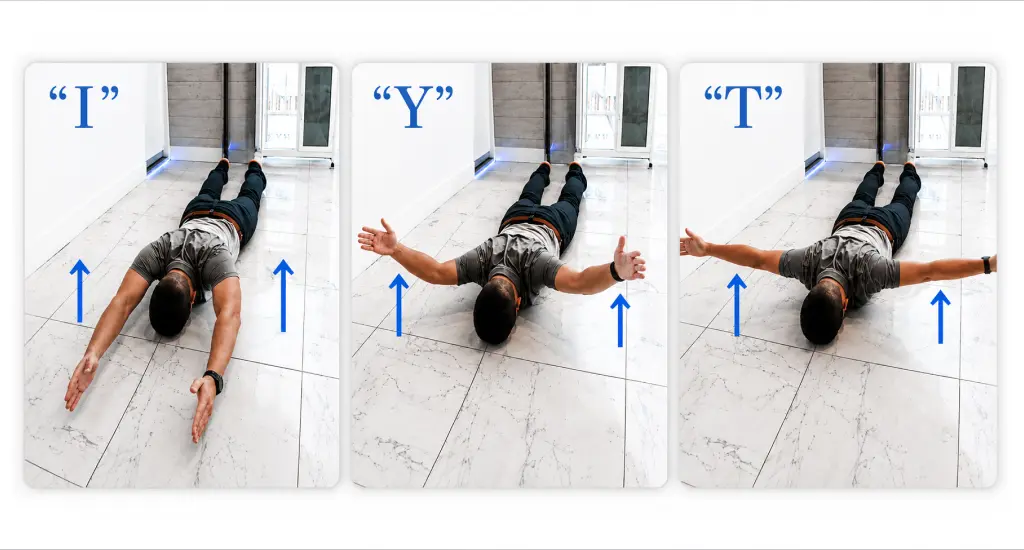
- Scapular Squeeze: Sit tall, draw both shoulder blades back and down, hold 5 seconds. 10 reps, 3x daily.
- Serratus Punch: Lie on your back, arm straight up, push the fist ceilingward by lifting the shoulder blade. 12 reps, 2 sets, daily.
- Lower Trap Setting at Wall: Face a wall, arms overhead in a Y, slide up without shrugging. 10 reps, 2 sets, daily.
- Band External Rotation: Elbow tucked at your side at 90 degrees, rotate the forearm outward. 15 reps, 3 sets, 4 days a week.
- Band Internal Rotation: Same position, rotate inward against the band. 15 reps, 3 sets, 4 days a week.
- Doorway Pec Stretch: Place your forearm on the frame at 45 degrees and step through. Hold 30 seconds, 3 times daily.
- Sleeper Stretch: Lie on the affected side, elbow at 90 degrees, gently rotate the forearm down. 30 seconds, 3 holds. For throwers with limited internal rotation.
- Standing Row: Band or cable, elbows close, squeeze the blades at the end. 12 reps, 3 sets, 3 days a week.
Exercises to Avoid With Shoulder Impingement
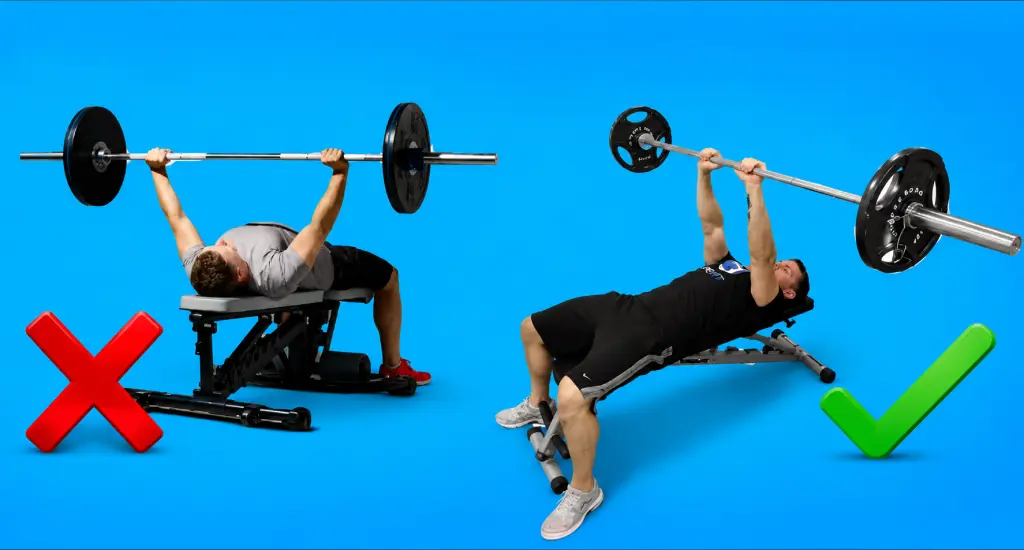
Avoid loading the painful arc while the shoulder is irritable. That rules out several gym staples:
- Overhead press and behind-the-neck pressing
- Heavy bench press, especially with a wide grip
- Upright rows, which force the exact pinching position
- Lateral raises above 90 degrees
- Pike push-ups and high-volume push-ups
This is “no pain, no gain” rehab. If an exercise sharpens the pain or leaves the shoulder worse the next morning, the load is wrong.
Lifters who need to keep training usually tolerate substitutes: bar hangs, chin-ups instead of wide pull-ups, isometric overhead holds, and banded Cuban rotations.
How Long Does Physical Therapy Take for Shoulder Impingement?
Most people notice real improvement within 2 to 6 weeks of starting physical therapy for shoulder impingement, with fuller resolution around 12 weeks. Harvard Health uses the same window and advises further evaluation if nothing has changed.
| Scenario |
Typical timeline |
| First noticeable improvement | 2 to 6 weeks |
| Fuller symptom resolution | About 12 weeks |
| Typical full plan of care | 6 to 12 weeks |
| Severe or long-standing cases | Up to 12 months |
| Rotator cuff tear healing after repair | 4 to 6 months |
| Subacromial decompression recovery | PT at 2 to 6 weeks, sport at 3 to 6 months, full recovery 6 to 12 months |
Shoulder impingement surgery recovery time runs longer than most people expect. Desk work returns within one to two weeks, but physical jobs and overhead sport take months.
What Makes Recovery Faster or Slower
Four factors move the timeline. How long you waited matters most, since a shoulder irritated for two years behaves differently from one irritated for six weeks. Age and stage matter, because Stage 3 tissue heals more slowly. Adherence matters, and a half-done program does not deliver half the result. Sleep matters, since unresolved night pain keeps the tendon sensitized.
What to Do When Shoulder Impingement Therapy Isn’t Working
Stalled rehab almost always has a specific cause, and repeating the same program is rarely the answer. Four patterns explain most of it.
- Your exercises irritate the shoulder: The phase is usually wrong, not the exercise. Band work in an angry shoulder that still needs isometrics feels useless, because pain inhibition blocks the muscle from firing.
- You plateau at 6 to 12 weeks: A plateau calls for reassessment, not more repetitions. The cuff may be strong while the shoulder blade has not changed. Retesting tells you which.
- The real driver was never found: Scapular dyskinesis, a stiff thoracic spine, GIRD in throwers, neck referral, and an undiagnosed partial tear are the usual misses. Lifters often find that scapular stability, not the cuff, was the real problem.
- You need daily anti-inflammatories to function: That is a signal, not a solution. Long-term daily NSAID use deserves a conversation with your physician, and a shoulder still needing them at week ten needs a fresh look.
Escalate to imaging, an injection, or a surgical consult when three months of progressed rehab has changed nothing.
Braces, Taping and Sleep: What Helps Between Sessions
A brace for shoulder impingement supports posture and comfort. It does not strengthen the shoulder or reopen the subacromial space.
Posture braces cue the shoulders back and reduce irritation during long desk hours, but the effect ends when you take the brace off. A sleeping brace limits the overnight positions that trigger pain. Kinesiology tape is the same idea: a temporary reminder, not a treatment.
Sleep position does more than any of them. Sleep on the opposite side with a pillow supporting the affected arm, and hug a second pillow to stop the shoulder rolling forward. Semi-reclined sleeping helps during the first painful weeks.
Therapy vs Cortisone vs Surgery: How to Decide
| Physical Therapy | Cortisone Injection |
Subacromial Decompression |
|
| Best for | Nearly all first presentations | Pain too high to start rehab | Failed conservative care, structural cause |
| Time to benefit | 2 to 6 weeks | Days | 3 to 6 months to sport |
| What it fixes | Mechanics and strength | Inflammation only | Bone or bursal obstruction |
| Downside | Requires consistent work | Minimal benefit alone, tendon risk | Long recovery, no guarantee |
Injections work best as a door-opener into rehab, not a replacement for it. Surgery becomes reasonable when imaging shows a structural cause and months of rehab have failed.
See a physician first if you cannot lift the arm after a fall, the shoulder looks deformed, you have fever with the pain, numbness or weakness runs into your hand, or night pain never changes with position.
Starting Shoulder Impingement Therapy in South Jersey
You do not need a referral to start physical therapy in New Jersey. Direct access has been law since 2003, so you can book an evaluation without waiting on a prescription.
Rehabletics is an out-of-network sports physical therapy clinic in Cherry Hill, so your carrier doesn’t limit how long you are seen or how many sessions you get. Every evaluation runs 60 minutes, one-on-one, with a Doctor of Physical Therapy. No techs, no handoffs.
Dr. Jaime Mor, PT, DPT, ATC, founded the clinic, and the team includes Dr. Erik Bonn, PT, DPT, MS, ATC. Evaluations include full-body orthopedic screening, force plate testing, and individual strength testing, so return-to-sport decisions rest on numbers. Athletes travel to Cherry Hill from Voorhees, Marlton, Mount Laurel, Haddonfield, and 12 more South Jersey towns.
Book your free 30-minute Comeback Call or call (609) 354-7987; we answer live seven days a week.
End Note
Shoulder impingement responds well when the plan has an order. Calm the pain, restore the shoulder blade, load the cuff, then return to what you want to do. Skipping ahead to loading turns a 12-week problem into a 12-month one.
If you are six weeks in and nothing has changed, that is information, not failure. Get reassessed, find the missed driver, and adjust. Most of these shoulders get better without an operating room.