


You lower your shoulder into a tackle, and suddenly a jolt of electricity shoots from your neck down to your fingertips. Your arm goes limp, and for a few scary seconds you cannot lift it. That is a stinger, also called a burner.
The good news: most burners and stingers fade within minutes and heal completely. Still, the same hit can cause more serious injuries, and repeat stingers can lead to lingering weakness.
Below, you will learn how long a stinger lasts, which warning signs need care, and when it is safe to play again. If symptoms linger, our sports injury physical therapy team in Cherry Hill can help you recover the right way.
What Are Burners and Stingers?
A stinger is a temporary injury to the nerves that run from your neck into your shoulder, arm and hand. It happens when those nerves are suddenly stretched, pinched or hit, which causes burning pain, numbness or weakness in one arm.
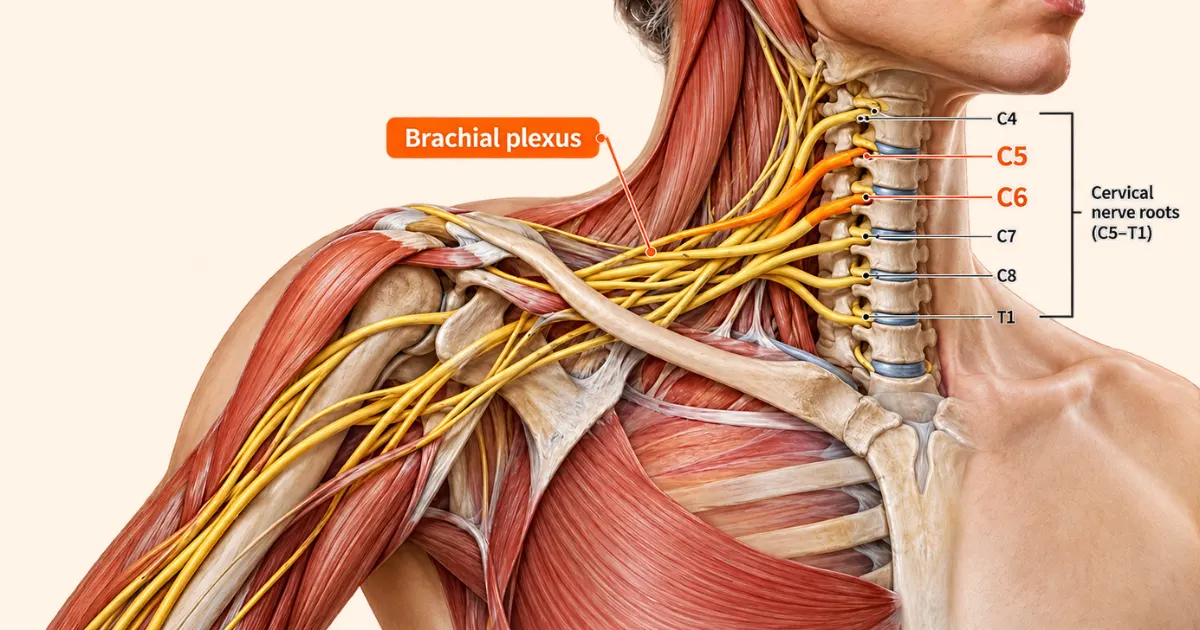
These nerves form a network called the brachial plexus. It starts at the nerve roots in your neck and controls feeling and movement in your entire arm. A brachial plexus stinger injury most often affects the C5 and C6 nerve roots, which power the shoulder and biceps. That is why your arm may feel weak when you try to lift it or bend your elbow.
Usually the nerve is only “stunned,” a short-lived injury called a neuropraxia. In football, a stinger happens when a big hit bends your neck sideways or drives your shoulder down.
Burner vs Stinger: Is There a Difference?
No. Burner and stinger are two names for the same injury. Some teams say “burner” because the pain burns, while others say “stinger” because it stings like an electric shock. The diagnosis, treatment and recovery are the same.
What Causes a Stinger in Football?
A stinger in football usually comes from one of three mechanisms:
- Traction (stretch): Your head is forced away from your shoulder while the shoulder is pushed down, stretching the nerves.
- Compression (pinch): Your head is driven toward the injured side and backward, pinching the nerve roots in your neck.
- Direct blow: A helmet or shoulder hits the area just above the collarbone, where the nerves sit close to the surface.
Tackling and blocking cause the most stingers, so defensive linemen, linebackers, offensive linemen, running backs and defensive backs are hit hardest. Studies report that about 50 to 65 percent of college football players have had at least one. That explains why NFL stinger injuries appear on injury reports nearly every week. In September 2026, Eagles running back Saquon Barkley left on the first snap with a stinger and returned after halftime once he was cleared.
Stingers also happen in wrestling, hockey, rugby, lacrosse and gymnastics, and they can follow a fall or a car crash. Risk rises with a narrow spinal canal (spinal stenosis), past stingers, a weak neck, poor tackling form and poorly fitted pads. See how stingers compare with other most common fall sports injuries.
What Does a Stinger Feel Like?
Athletes describe a stinger in football as a lightning bolt down the arm. Common symptoms include:
- A sudden burning, stinging or electric-shock feeling from the neck or shoulder into the hand
- Numbness or tingling in the arm or fingers
- A warm sensation in the arm
- A “dead arm” that hangs limp or is held against the body like a chicken wing
- Weakness when lifting the arm, bending the elbow or gripping
- Neck stiffness or muscle spasm that shows up later
A true stinger affects only one arm. Many athletes keep quiet because they fear being pulled from the game, but always tell your athletic trainer, even if the feeling passes quickly.
How Long Does a Stinger Last?
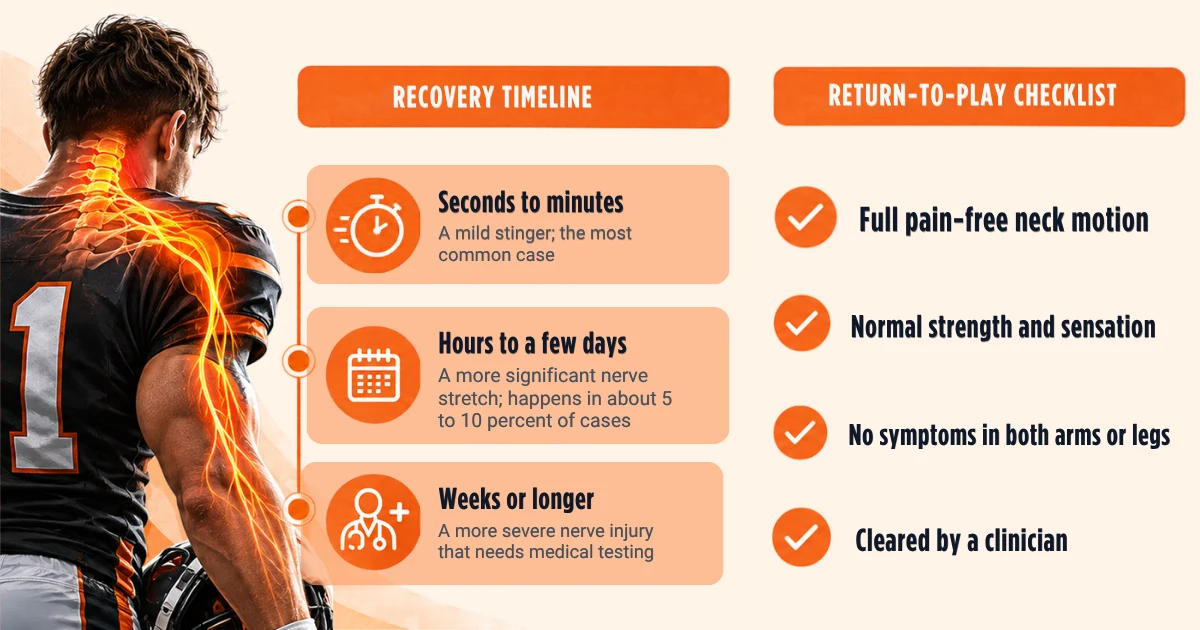
Most stingers last a few seconds to a few minutes. A smaller group, roughly 5 to 10 percent, keep symptoms for hours, days or even weeks. In football, many players return in the same game, but only after a full exam shows normal strength and no lingering symptoms.
Total stinger injury recovery time depends on how much the nerve was damaged:
|
Grade |
What happens to the nerve | How long symptoms last |
Typical recovery |
| Grade 1 (neuropraxia) | Nerve is stunned but intact | Seconds to minutes, sometimes days | Full recovery, often the same day |
| Grade 2 (axonotmesis) | Inner nerve fibers are damaged | Weakness for weeks | Full recovery in weeks to a few months with rehab |
| Grade 3 (neurotmesis) | Nerve is torn; rare in sports | Months | May need surgery and a long rehab |
Pain usually fades first, while weakness can take longer to clear.
Neck Stinger vs Shoulder Stinger Recovery Time
Neck stinger recovery time is often longer. When the nerve root is pinched in the neck, symptoms may linger for days and come back with the next hit, especially in athletes with a narrow spinal canal. Shoulder stinger recovery time is usually shorter, because a stretch of the nerves near the shoulder typically clears within minutes to a few days. Either way, strength must be fully back before contact.
Are Neck Stingers Dangerous?
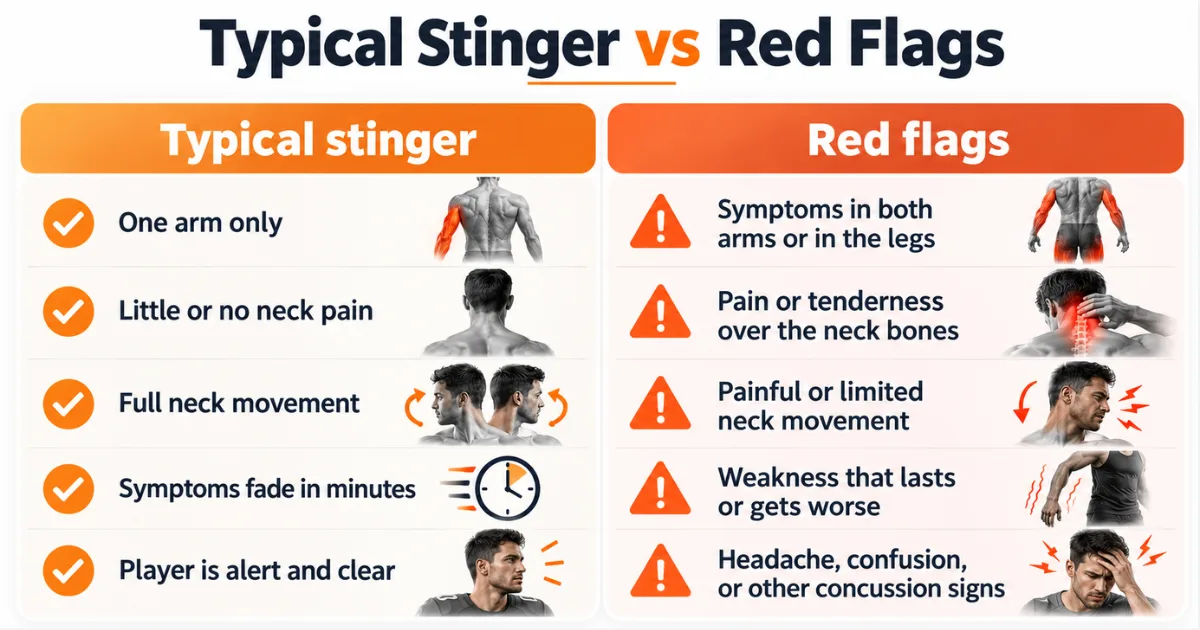
A single stinger is usually not dangerous. The concern is that the hit causing it can also cause a concussion, a disc injury or a spinal cord injury. Get emergency care if any of these appear:
- Symptoms in both arms, or in your legs
- Pain directly over the bones of your neck
- Confusion, headache, memory problems or loss of consciousness
- Weakness that lasts more than a few days
- A second or third stinger in one season
|
Injury |
Sides affected | Main signs |
What to do |
| Stinger | One arm | Burning, numbness, brief weakness | Remove from play until fully cleared |
| Concussion | Brain | Headache, confusion, dizziness, memory or balance problems | Remove from play; concussion protocol |
| Pinched nerve | Usually one arm | Neck pain plus arm pain that builds or lingers | Medical and PT evaluation |
| Spinal cord injury | Both arms or legs | Numbness or weakness on both sides | Call 911; do not move the athlete |
Not sure where to start? This guide on choosing between urgent care or a sports physical therapist can help.
Stinger vs Concussion
A stinger injures the nerves to your arm, while a concussion injures your brain. Arm burning and weakness point to a stinger. Headache, fogginess, dizziness, nausea or memory gaps point to a concussion. Because one helmet-to-helmet hit can cause both, every athlete with a stinger should also be screened for concussion.
Stinger vs Pinched Nerve
A stinger comes on suddenly from a hit and usually clears quickly. A pinched nerve, called cervical radiculopathy, often comes from a disc or bone spur, builds over time and brings real neck pain. Tilting the head toward the sore side often reproduces the arm pain. If your symptoms linger, our neck pain treatment in Cherry Hill finds the true source.
How Is a Stinger Diagnosed?
A stinger is diagnosed mainly from how the injury happened and a hands-on exam. Your clinician tests shoulder and elbow strength, reflexes, sensation and neck motion. A true stinger usually has no neck pain and a negative Spurling’s test, a neck compression test for pinched nerves.
Imaging is needed only for red flags, repeat stingers or weakness lasting several days. X-rays and MRI check the spine and spinal canal. A nerve study (EMG) can measure nerve damage after about three weeks of weakness, but it is not used to clear return to play because results can stay abnormal after recovery. If you are unsure whether you need an exam, read when to see a sports physical therapist.
Stinger Injury Treatment: From the Sideline to Full Strength
Stinger injury treatment starts the moment it happens. Leave the field and do not return until you are checked. Then:
- Ice the neck and shoulder for 15 to 20 minutes at a time
- Rest from contact and heavy lifting
- Take an over-the-counter anti-inflammatory if your doctor says it is safe
Most Grade 1 stingers need nothing more. When symptoms last beyond a day or two, shoulder stinger therapy with a sports physical therapist speeds recovery and lowers the risk of a repeat. Care usually includes:
- Hands-on care: Gentle manual therapy to ease neck stiffness and restore joint motion.
- Muscle tension relief: Dry needling for neck and shoulder tension to calm protective muscle guarding.
- Nerve glides: Gentle movements that help the irritated nerve slide freely.
- Strength and control: Progressive work for the neck, shoulder blades and rotator cuff.
- Posture coaching: Better head and shoulder position for practice, lifting and daily life.
Shoulder Stinger Rehab Exercises
Begin these only after a clinician clears you and moving your neck no longer sends symptoms down your arm. Stop any exercise that brings back tingling or weakness.
- Calm and restore (first days): Do chin tucks for 10 reps with a 5-second hold, then gentle neck turns and side bends within a comfortable range. Add shoulder blade squeezes, pulling your shoulders back and down for 10 reps.
- Isometrics (once motion is easy): Press your hand into your forehead, the back of your head and each side of your head without letting your neck move. Hold each for 5 to 10 seconds, 5 times. Add gentle shoulder isometrics against a wall.
- Strength and power (once isometrics are pain-free): Add resistance band rows, band pull-aparts, shrugs and band external rotation for the rotator cuff. Progress to prone Y, T and W raises, then band or partner neck resistance in all four directions.
For lingering shoulder weakness, our shoulder pain rehab builds a plan around your sport and position.
Can You Play Football With a Stinger?
No. You should not play while any stinger symptoms remain, because a weak arm cannot protect your neck and shoulder. You are ready to return when:
- Burning, numbness and tingling are completely gone
- You have full, pain-free neck motion
- Arm strength matches your other side
- You have no neck pain, and neck compression tests are negative
After a first stinger that clears in minutes, a same-game return can be safe once an athletic trainer or doctor confirms it. After a repeat stinger or symptoms lasting longer, expect a longer break and a fuller workup before contact.
Chronic Stinger Syndrome: When Stingers Keep Coming Back
Stingers come back often, with recurrence rates reported as high as 87 percent in college football. Each repeat episode tends to last longer. Over time, some athletes develop chronic stinger syndrome, in which neck and shoulder pain, tingling and weakness no longer fully go away between hits.
Chronic stingers are often linked to a narrow spinal canal or disc changes in the neck. The next step is a complete evaluation with imaging, a dedicated strengthening program and equipment changes, plus an honest talk about tackling style or position. Most athletes still return to play with the right care. To break the cycle for good, learn why sports injuries keep coming back.
How to Prevent Stingers in Football
You cannot remove all risk from a contact sport, but you can lower it a great deal:
- Tackle with your head up. Never spear or lead with the crown of your helmet.
- Build neck strength year-round. A strong neck resists the sideways whip that stretches the nerves.
- Strengthen your upper back and shoulders. Good shoulder blade control keeps the shoulder from being driven down.
- Wear properly fitted shoulder pads. Loose or worn pads leave the neck exposed.
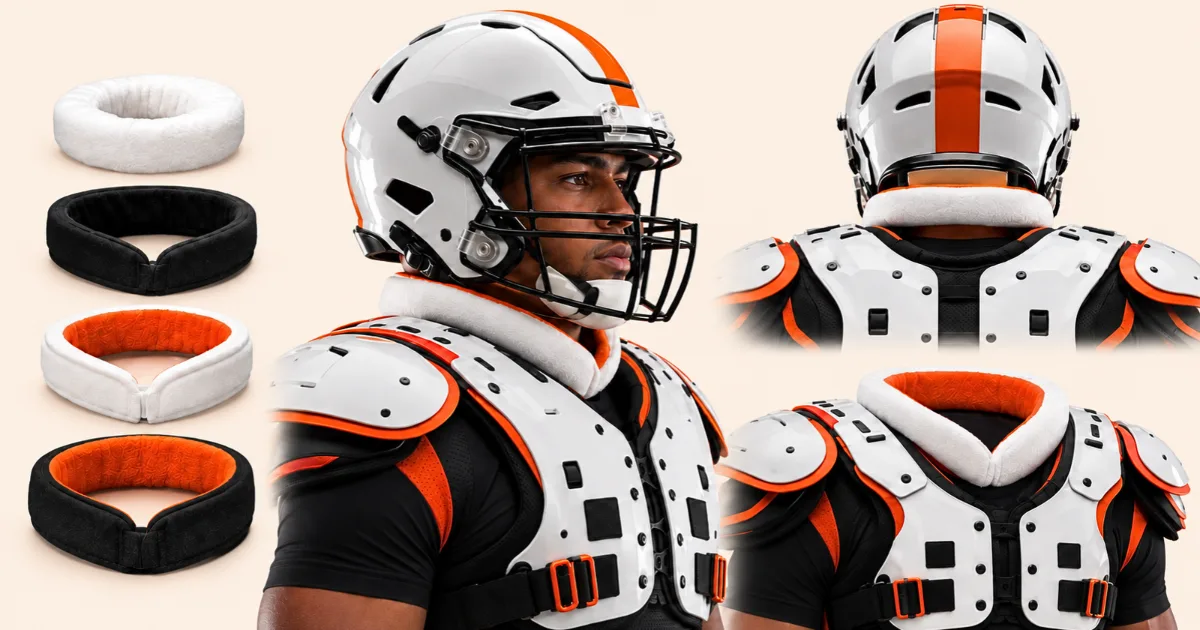
- Add extra protection after a stinger. A neck roll, a cowboy collar or spider pads under the shoulder pads limit neck motion.
- Keep your neck mobile. Gentle stretching before practice prepares the tissues for contact.
A preseason screening can spot weak links before the first hit of the season.
Stinger Rehab in Cherry Hill, NJ

At Rehabletics, every stinger plan starts with a full evaluation of your neck, shoulder and nerve function, followed by one-on-one care. Our clinic is led by Dr. Jaime Mor, PT, DPT, ATC, a sports physical therapist and certified athletic trainer. Our team serves as a sports physical therapy contractor for the Philadelphia Flyers and Philadelphia Eagles.
Come see us at 5 Esterbrook Lane in Cherry Hill if you have weakness lasting more than a few days, a second stinger, or need a return-to-play check before the next game.
Get Back on the Field With Confidence
Do not let a stinger turn into a lost season. Book a free consultation for a full evaluation and a clear return-to-play plan. With no referral needed in New Jersey, you can start rehab right away.