


A bone stress injury happens when repeated running loads damage bone faster than your body can repair it. Female runners face roughly twice the risk of male runners, mainly because of low energy availability, hormonal changes, and lower bone density. Most stress fractures in female runners heal fully without surgery when caught early. Here is how to spot one and how our team approaches treating running injuries so you return stronger.
What Is a Bone Stress Injury?
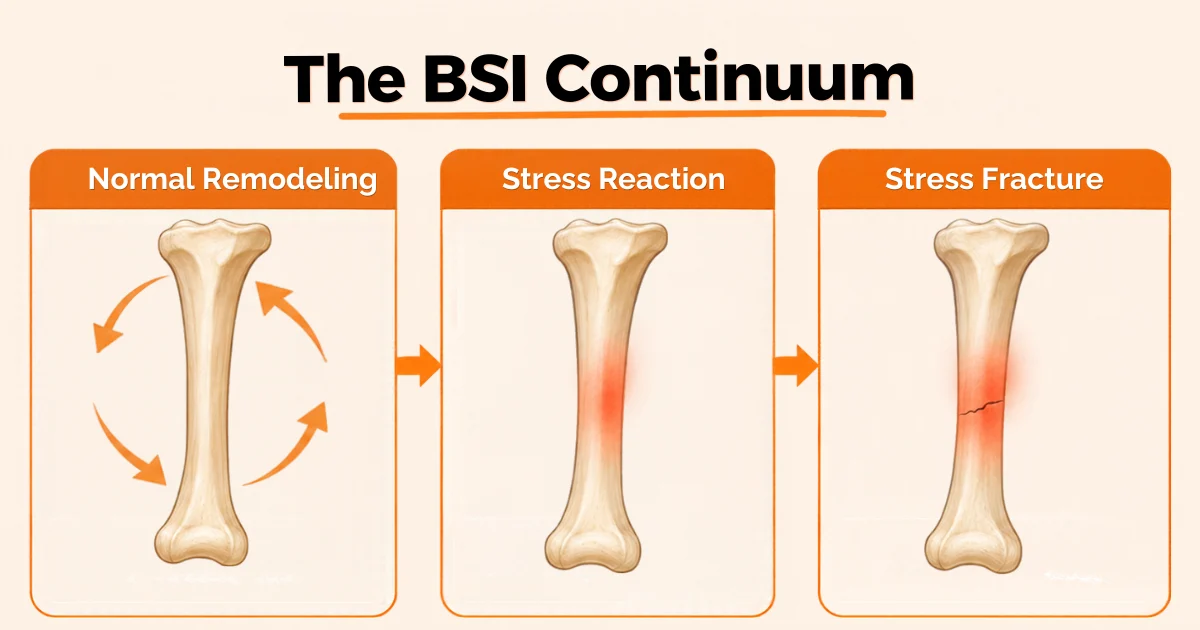
A bone stress injury (BSI) is an overuse injury caused by repeated stress on the skeleton. Every run creates tiny areas of microdamage that your body normally repairs during recovery. When training load outpaces that repair, the damage builds up.
BSIs sit on a continuum:
|
Stress Reaction |
Stress Fracture |
|
| What happens | Swelling inside the bone, no break | A visible fracture line |
| Imaging | Seen on MRI | Seen on MRI, sometimes X-ray |
| Outlook | Shorter time away from running | Longer, closely supervised recovery |
Why Female Runners Face a Higher Risk
Research on bone stress injuries in female athletes is consistent: women get them more often. Among NCAA athletes, the rate is about 9.13 per 100,000 for women versus 4.44 for men. Smaller bone size, the protective role of estrogen, and higher rates of under-fueling all contribute.
What Causes Stress Fractures in Runners?
Most stress fractures come from a mismatch between load and recovery. Common triggers include:
- Increasing mileage, speed, or hills too quickly (pain often appears 4 to 6 weeks later)
- Running more than about 20 miles per week
- Training on hard surfaces or in shoes past 300 to 500 miles
- Having weak hips, calves, or core muscles
- Having a previous BSI, a history of shin splints, or less than 6.5 hours of sleep
These are classic overuse injuries in athletes: no single run causes them, but the total load does.
The Female Athlete Triad and RED-S
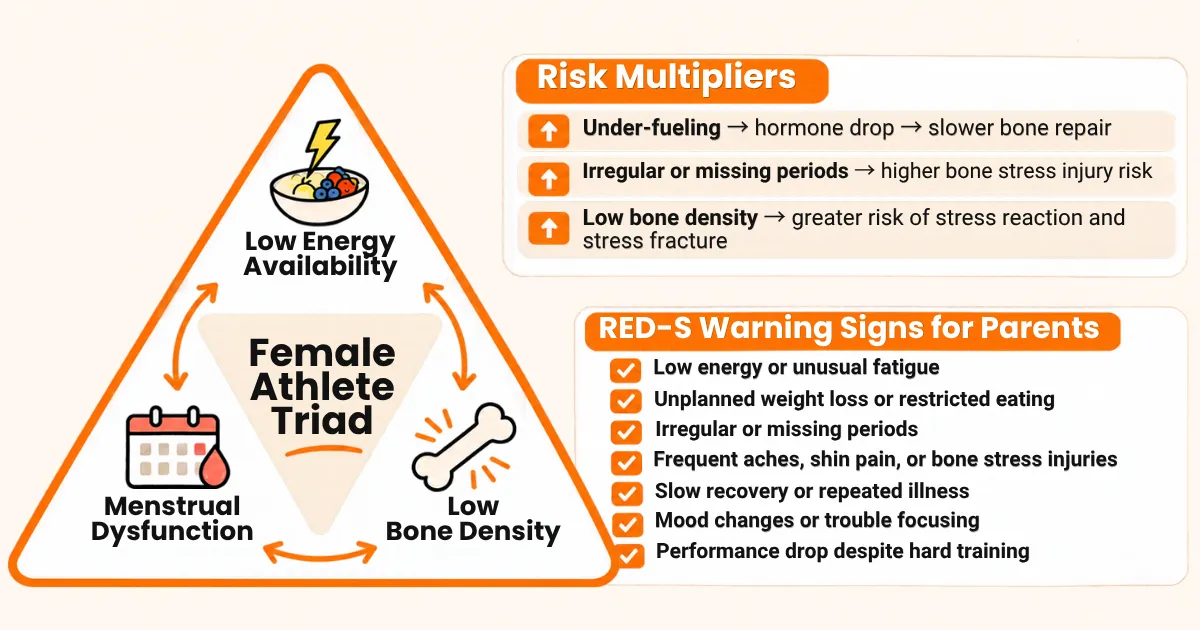
The Female Athlete Triad links three problems: low energy availability, menstrual dysfunction, and low bone mineral density. Relative Energy Deficiency in Sport (RED-S) is the broader model, showing how under-fueling also affects metabolism, immunity, mood, and performance.
Low energy availability means you are not eating enough to cover both training and basic body functions. Estrogen then drops, periods become irregular or stop, and bone loses its ability to rebuild.
How the Female Athlete Triad Raises Fracture Risk
The link between the female athlete triad and stress fractures is strong. One Triad factor raises stress fracture risk about 2.5 times, and two or more raise it about 4.7 times. Amenorrhea, meaning no periods for three months or more, has been linked to a risk nearly 13 times higher. Female runners taking in less than 800 mg of calcium a day also had about six times more BSIs than those getting 1,500 mg.
RED-S Warning Signs Parents Miss

Many early signs of RED-S look like normal hard training. Watch for:
- Periods that stop, or cycles shorter than 21 days or longer than 35 days
- No first period by age 15 or 16
- Constant fatigue or lightheadedness
- Frequent colds, slow healing, or repeat injuries
- Performance that drops despite hard work
- Skipped meals around practice
A normal body weight does not rule out RED-S. Our guide on which supplements athletes actually need is a practical place to start.
Bone Stress Injuries in Female Cross Country Runners

High school and college cross country runners deserve extra attention. The teen years are when girls build most of their peak bone mass, so under-fueling now can affect bone health for life. A late first period, a lean-focused team culture, and a big preseason mileage jump all stack the risk. Parents and coaches help most by making sure athletes eat before and after practice and by keeping conversations about performance, not weight.
Where Do Runners Get Stress Fractures?
The tibia (shin bone) and the metatarsals in the foot are the most common sites. Location matters because some bones heal reliably while others carry a higher risk of complications.
|
Lower-Risk Sites |
Higher-Risk Sites |
| Inner (posteromedial) tibia | Femoral neck (hip) |
| Second to fourth metatarsals | Front (anterior) tibia |
| Fibula | Navicular (midfoot) |
| Calcaneus (heel) | Base of the fifth metatarsal |
| Sacrum and pelvis (moderate risk, more common in women) |
Higher-risk sites heal more slowly and can break completely if loading continues. Because many of these injuries show up as foot pain, our foot pain treatment page explains how we assess them.
Early Symptoms You Should Not Run Through
The classic sign is pain that worsens as you run instead of easing after your warm-up. Other red flags include:
- Pinpoint tenderness you can cover with one finger
- Pain when walking, at rest, or at night
- Swelling over the bone
- Pain when hopping on the injured leg
Deep groin or hip pain can signal a femoral neck injury, so stop running and get assessed promptly.
How Is a Bone Stress Injury Diagnosed?
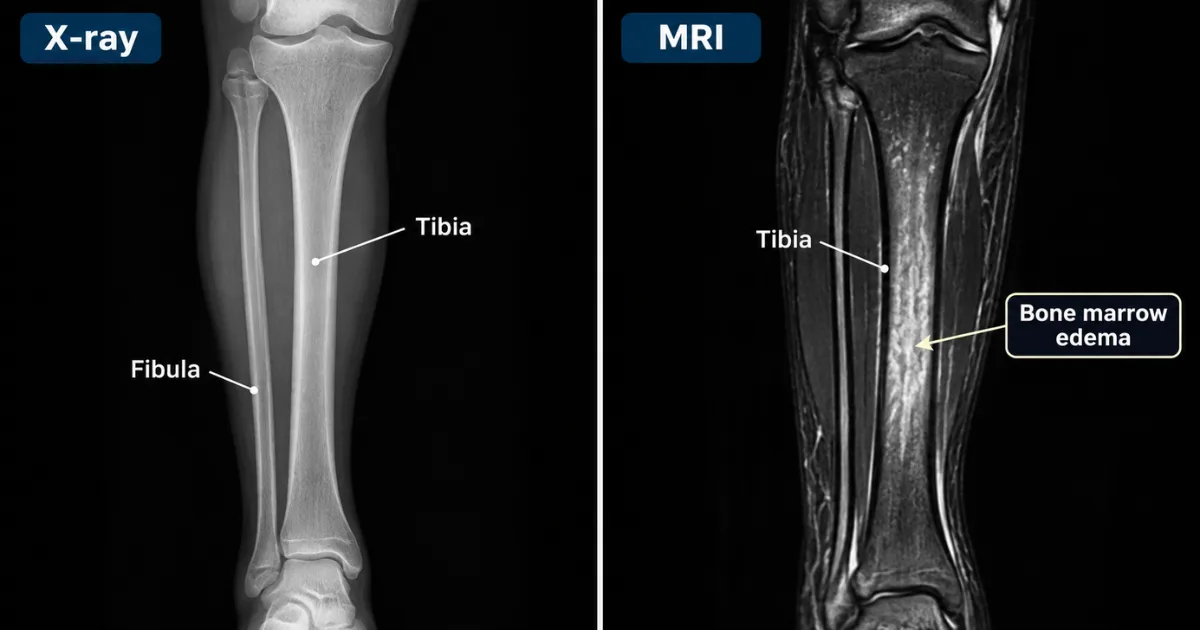
MRI is considered the gold standard imaging modality for diagnosing a bone stress injury. It detects bone swelling early and grades severity from grade 1 to grade 4. X-rays catch only around 10% of early injuries. After a repeat or high-risk injury, a DEXA bone density scan and blood work for vitamin D and hormones help uncover the cause.
Treatment and Return to Running
Treatment starts with removing the load that caused the injury. Low-risk injuries usually need relative rest from running, while high-risk injuries may need a boot or crutches. Avoid relying on anti-inflammatory painkillers, since they can mask pain and may slow bone healing.
You do not have to lose your fitness. Pool running and cycling keep you conditioned, and blood flow restriction training maintains muscle with light loads that protect healing bone. Running restarts with a gradual run-walk progression once walking and hopping are pain-free.
|
MRI Grade |
Typical Return to Running |
| Grade 1 | About 3 weeks |
| Grade 2 | About 5 to 6 weeks |
| Grade 3 | About 11 weeks |
| Grade 4 | About 14 weeks or more |
Objective measures such as force plate testing help confirm both legs are ready for impact.
How to Prevent a Repeat Bone Stress Injury
In one survey, 37% of female runners with a stress fracture reported more than one. Build mileage gradually, add strength and jumping drills, aim for 1,000 to 1,300 mg of calcium plus enough vitamin D, sleep at least seven hours, and track your cycle. You can also learn why sports injuries keep coming back.
Get Back to Running Stronger in Cherry Hill
At Rehabletics in Cherry Hill, Dr. Jaime Mor, PT, DPT, ATC, and our team combine gait analysis, bone-safe loading, and return-to-run testing for runners across South Jersey. Do not wait for a nagging ache to become a fracture. Book a free consultation.