

Most AC joint separations heal in about 2 to 12 weeks without surgery, depending on the grade. Mild sprains often settle in 1 to 3 weeks, while a grade 3 separation usually takes 6 to 12 weeks. If surgery is needed, expect about 4 to 6 months before full contact or overhead lifting. The good news for athletes is that most separated shoulders are low grade and respond well to rehab. If you want a plan built around your sport, our shoulder pain treatment in Cherry Hill starts with a hands-on evaluation that grades the injury and maps your return.
What Is an AC Joint Separation?
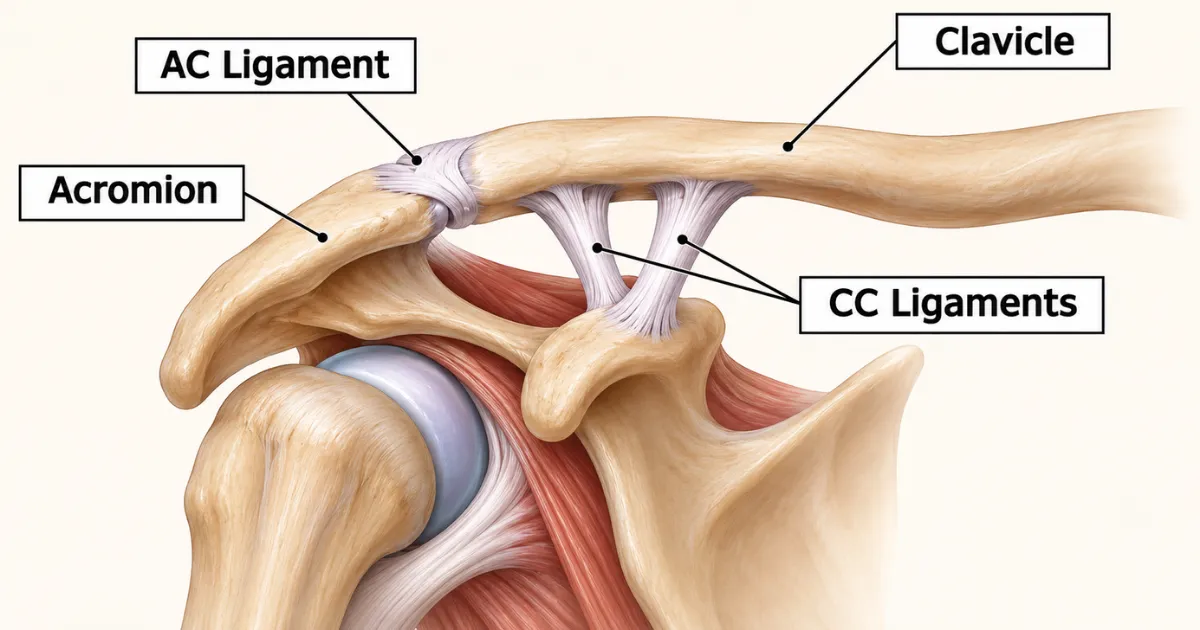
A separated shoulder is a sprain of the acromioclavicular (AC) joint, where your collarbone meets the acromion at the top of the shoulder blade. Two sets of ligaments hold it together: the AC ligaments and the stronger coracoclavicular (CC) ligaments. It is not a true shoulder dislocation because the ball and socket stay in place.
It usually happens from a fall or a hit on the point of the shoulder. In college football, AC joint injuries make up 41 percent of all shoulder injuries (Dragoo et al., American Journal of Sports Medicine, 2012).
AC joint pain sits right on top of the shoulder. It gets worse when you reach overhead, reach across your body, or sleep on that side, and it often comes with swelling or a bump.
AC Joint Separation Recovery Time by Grade
Recovery time depends on which ligaments are torn and how far the collarbone moves.
| Grade | What is injured | What you may see | Usual treatment | Typical recovery |
| 1 | AC ligament sprained | Tenderness, no bump | Short sling use, rehab | 1 to 3 weeks |
| 2 | AC ligament torn, CC ligaments sprained | Small bump | Sling, rehab | 2 to 6 weeks (up to 3 months to feel normal) |
| 3 | AC and CC ligaments torn | Obvious bump | Rehab first in most cases | 6 to 12 weeks without surgery; 4 to 6 months with surgery |
| 4 | Collarbone pushed backward | Rare, severe pain | Surgery | About 4 to 6 months after surgery |
| 5 | Collarbone far above the shoulder, muscle attachments torn | Large deformity | Surgery | About 4 to 6 months after surgery, sometimes longer |
| 6 | Collarbone pushed below the coracoid | Very rare | Surgery | Individual |
Grades 1 and 2: Mild Separations
A mild AC joint separation is the most common type. Grade 1 recovery time is usually 1 to 3 weeks, and many athletes return once the joint is no longer tender. Grade 2 recovery time is usually 2 to 6 weeks for daily activity. Heavy pressing and contact can feel off for up to 3 months.
Grade 3: The Rehab or Surgery Question
Grade 3 AC joint separation recovery time is about 6 to 12 weeks with rehab alone, and rehab first is now the standard approach. Surgery is usually considered only if pain or weakness persists after about 3 months, or for some overhead athletes and laborers. The bump usually stays without surgery, but most people regain full function.
Grades 4, 5 and 6: Surgical Injuries
These grades are rare and usually come from high-energy trauma. Grade 4 and grade 5 recovery time is typically 4 to 6 months after reconstruction, followed by a gradual return to full sport.
Week-by-Week Recovery Without Surgery
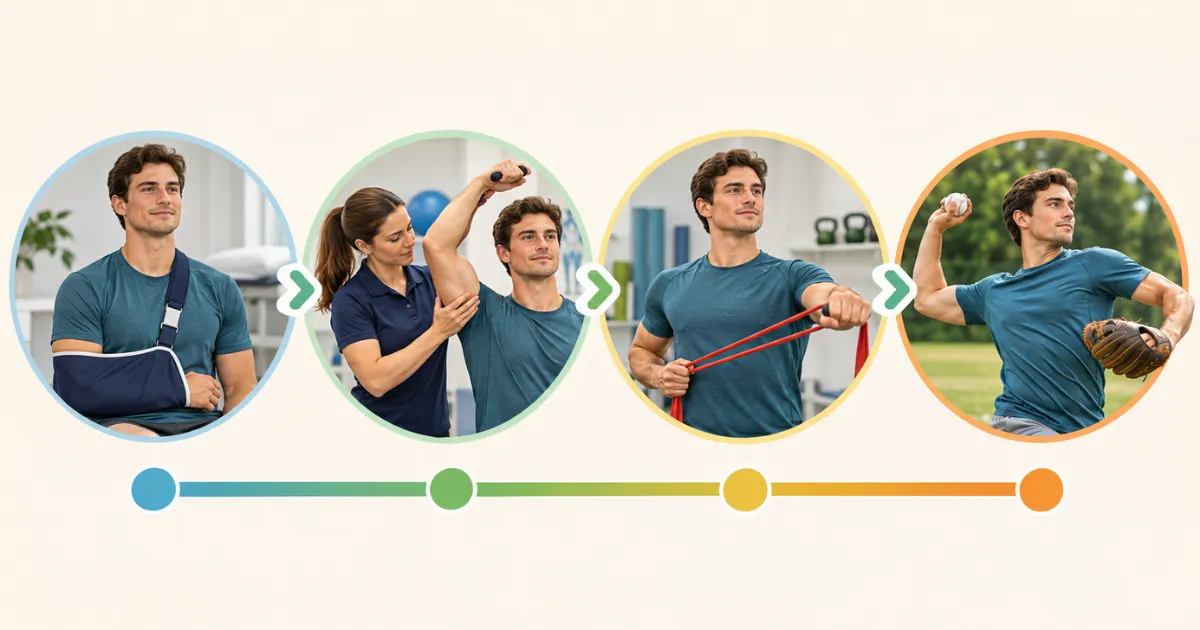
Here is what a typical non-surgical recovery looks like:
- Days 1 to 7: Protect the joint with a sling, ice it, and control pain.
- Weeks 1 to 2: Start gentle motion and wean off the sling as pain allows.
- Weeks 2 to 6: Restore full range of motion and begin light strengthening.
- Weeks 6 to 12: Build sport-specific strength and return to contact last.
Your progress should follow symptoms and testing, not just the calendar. A grade 1 athlete may move through these stages in days, while a grade 3 athlete will need the full window.
AC Joint Separation Surgery Recovery Time
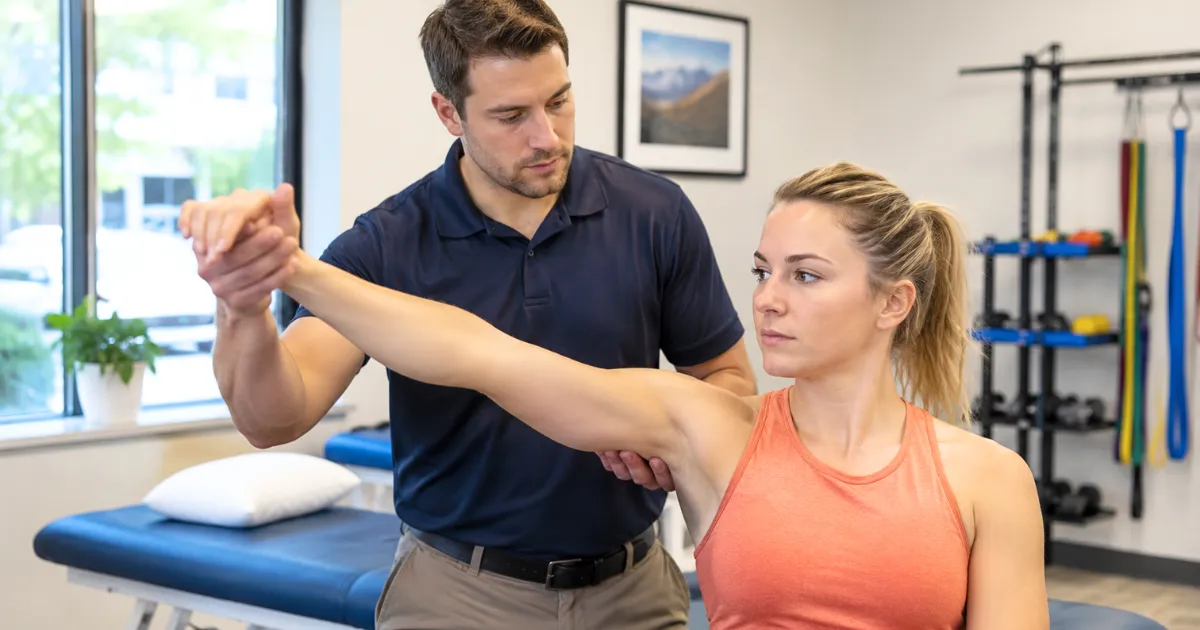
AC separation surgery recovery time is longer because the reconstructed ligaments need time to heal before they take load:
- Weeks 0 to 6: Sling protection, with gentle pendulums only.
- Weeks 6 to 12: Supervised range of motion. Most people can drive around 6 weeks.
- Months 3 to 4: Progressive shoulder and shoulder blade strengthening.
- Months 4 to 6: Overhead lifting, throwing and contact sports.
Loading the repair too early can cause it to lose position, so structured rehab matters. Our post-surgical rehabilitation program works alongside your surgeon’s protocol to protect the repair and rebuild strength step by step.
AC Joint Separation Recovery Exercises by Phase
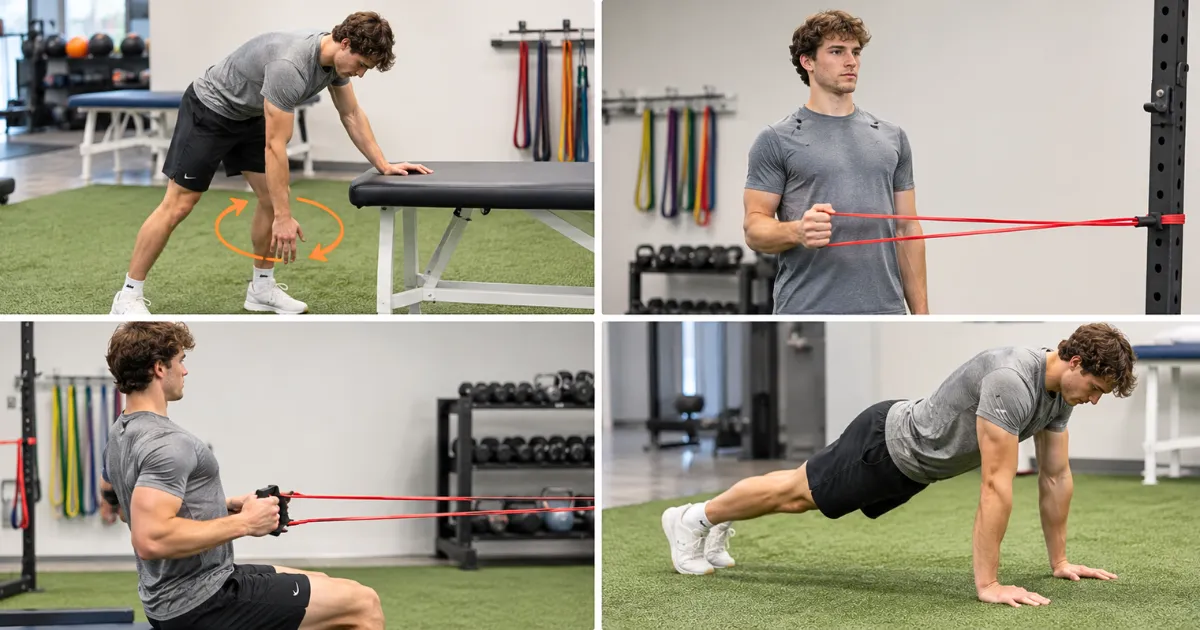
Good AC joint separation treatment combines pain control with progressive loading. These are common exercises, but your physical therapist should set the timing:
- Early phase: Pendulums, table slides, and pain-free shoulder isometrics.
- Middle phase: Band external and internal rotation, rows, scapular squeezes and wall slides.
- Late phase: Push-up plus progressions, landmine presses and sport-specific drills.
Avoid bench press, dips, behind-the-neck pressing and heavy cross-body loading early on, because they compress the AC joint.
When heavy weights are off the table, blood flow restriction training helps you keep muscle and strength with light loads. Many athletes also find kinesiology taping helpful for comfort and support during longer sessions.
Returning to Football and Contact Sports
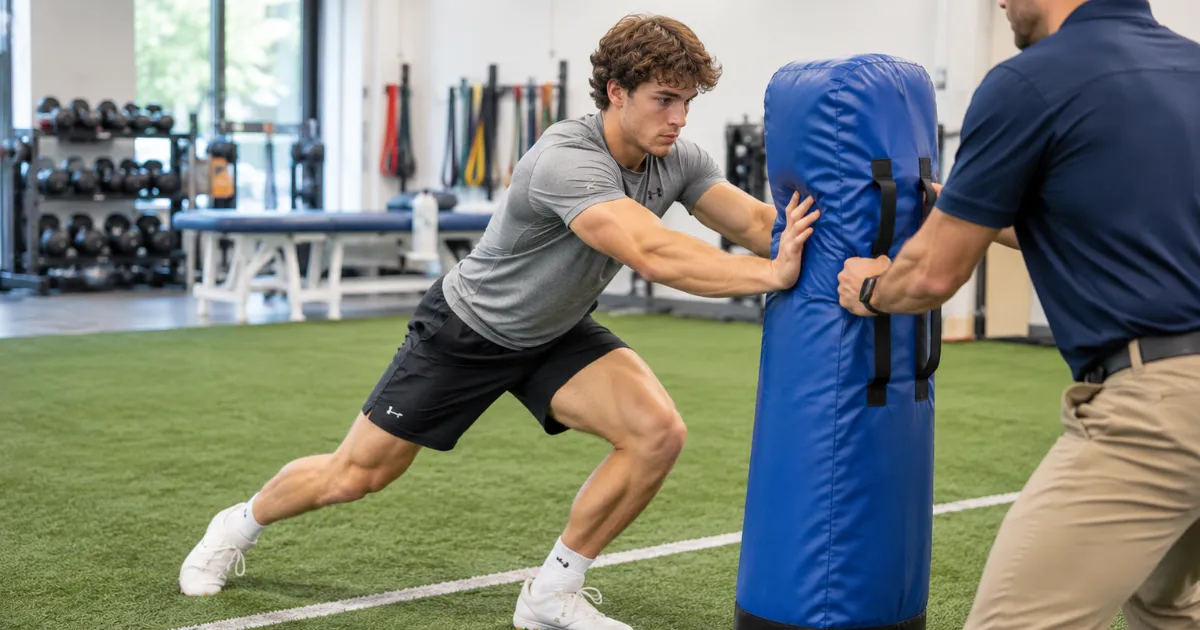
Most football players with a separated shoulder get back quickly. In the NCAA data, the average time lost was 11 days, and only 2 percent of AC injuries needed surgery.
You are generally ready to return when you have:
- Full, pain-free range of motion
- No tenderness over the AC joint
- No pain reaching across your body
- Strength close to your other side
- Pain-free tackling, blocking or throwing drills
An AC joint pad under your shoulder pads adds protection. If you are not sure whether you are ready, read our guide on when to see a sports physical therapist.
Why Your AC Joint Still Hurts Months Later
Lingering AC joint irritation is common when athletes return too fast, skip shoulder blade strengthening, or go back to heavy pressing too soon. Lifters can also develop early AC joint arthritis or wear at the end of the collarbone. Get rechecked if pain is not improving month to month, or if overhead weakness persists. Our article on physical therapy for shoulder pain explains how a targeted plan calms these symptoms.
Get Back to Your Sport With Rehabletics in Cherry Hill
Dr. Jaime Mor, PT, DPT, ATC, and our team build one-on-one rehab plans that get athletes back to full strength. You can start with direct access to physical therapy in NJ, with no referral needed. When you are ready, book a call with our team.