



Your surgeon cleared you. Your knee stopped hurting weeks ago. Then you tried to cut hard on it, and your body said no. That gap is what an advanced sports rehabilitation program exists to close. Standard physical therapy helps you walk, lift groceries, and sleep through the night. Advanced sports rehab gets you back on the field at the speed, force, and confidence you had before the injury.
The difference is not fancier equipment. It is measurement, sport-specific loading, and a clear set of tests you must pass before anyone clears you. This guide shows you the seven markers that separate a real advanced program from a rebranded one. Read on before you book your next appointment.
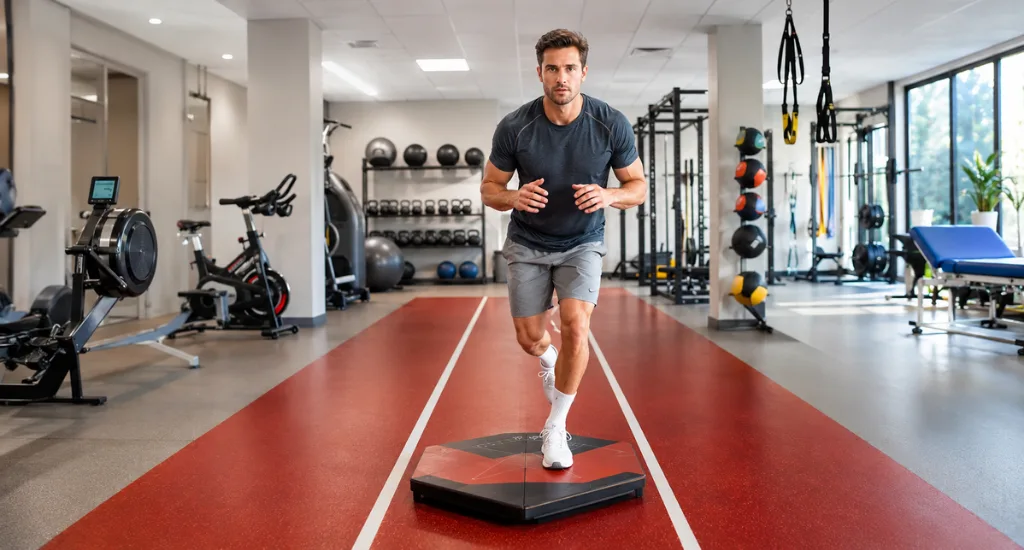
What Makes an Advanced Sports Rehabilitation Program Different?
An advanced sports rehabilitation program is different because it treats the whole movement system, measures progress with objective data, and clears athletes on test results rather than a calendar.
Six things set it apart:
- Kinetic chain focus: Clinicians assess the entire connected movement system, not only the painful joint.
- Objective testing: Force plates and handheld dynamometers replace guesswork about strength and symmetry.
- Criteria-based progression: You advance when you pass a benchmark, not when a set number of weeks has passed.
- Neurocognitive training: Reaction and decision drills retrain the brain-body link under fatigue.
- Sport-specific loading: Sessions rebuild the cutting, sprinting, and jumping demands of your sport.
- Psychological readiness: Confidence and fear of re-injury are treated as clearance criteria.
General physical therapy restores daily function. Advanced sports rehabilitation restores athletic performance. Both matter, but only one prepares you for competition.
What Is Sports Rehabilitation, and What Makes It “Advanced”?
Sports rehabilitation is the structured treatment of athletic injuries aimed at returning a person to their sport safely. It combines manual therapy, progressive strength work, movement retraining, and return-to-sport testing.
“Advanced” is earned through three things: objective measurement, sport-specific programming, and criteria-based clearance. A clinic that adds a light-reaction board but still discharges patients by week number is not running an advanced program.
Who advanced sports rehabilitation is for
Advanced sports rehab serves anyone whose goal is performance, not just comfort. That includes post-surgical athletes recovering from ACL reconstruction, high school and college competitors, weekend runners and cyclists, adults over 40 returning to pickleball or tennis, and anyone dealing with a recurring injury.
Advanced Sports Rehabilitation vs Standard Physical Therapy
Advanced sports rehabilitation differs from standard physical therapy in its endpoint, its testing, and its intensity. Standard PT ends when you function normally. Advanced sports rehab ends when you pass a return-to-sport test battery.
| Factor | Standard Physical Therapy | Advanced Sports Rehabilitation |
| Primary goal | Reduce pain, restore daily function | Restore full athletic performance |
| Endpoint | Walking, stairs, work tasks | Measured clearance to compete |
| Progression | Time and visit-based | Criteria and data-based |
| Assessment | Visual and subjective | Force plates, dynamometry, symmetry scores |
| Exercise focus | Isolated muscles and joints | Kinetic chain and sport movements |
| Intensity | Gradual and conservative | Progressively loaded and demanding |
| Care team | Solo physical therapist | PT plus athletic trainer, strength coach, physician |
Why this matters: returning to sport without meeting strength benchmarks raises re-injury risk. Nowak Orthopedic Associates lists a limb symmetry index above 90 percent as a core requirement for return to sport. Most general programs never measure that number at all.
The 7 Markers of a Truly Advanced Sports Rehab Program
1. It treats the entire kinetic chain
The kinetic chain is the connected system of joints and muscles that share load during movement. Advanced programs assess it end-to-end. Weak hips often drive knee pain. A stiff ankle changes how you land. Treating only the sore spot leaves the cause in place, so the injury returns.
2. It measures instead of guessing
Objective testing replaces opinion with numbers. Select Physical Therapy uses VALD ForceDecks, a dual-force-plate system that measures jump height, landing force, balance, and left-to-right asymmetry. Handheld dynamometers, such as the VALD DynaMo, isolate quad and hamstring strength. You get a score, not a shrug.
3. Progression is criteria-based, not calendar-based
Criteria-based rehab advances you as you meet functional benchmarks. Time-based rehab advances you when the weeks run out. Nowak Orthopedic Associates notes that time-based progression carries a higher risk of re-injury. Advanced programs publish the benchmarks up front, so you always know what you are working toward.
4. It keeps you training in the presence of injury
Advanced programs train every part of the body the injury does not affect. A runner with a hamstring strain can still build upper-body strength and aerobic capacity. This prevents the deconditioning that passive rest causes, and it shortens the ramp back to full training.
5. It trains the brain, not just the muscle
Neurocognitive training rebuilds reaction speed and decision-making under fatigue. Select Physical Therapy uses BlazePod light-reaction pods and the Quick Board agility system for this work. Sport happens fast and unplanned. A knee that is strong in a controlled squat can still fail during a reactive cut.
6. The exercises replicate your actual sport
Sport-specific rehabilitation rebuilds the exact demands you will face. A soccer player trains deceleration and change of direction. A pitcher trains overhead velocity and deceleration of the arm. Physiopedia states that rehabilitation programs must reproduce the movements required for the athlete to return to the field.
7. It addresses psychological readiness
Fear of re-injury keeps healthy athletes off the field. Advanced programs treat confidence as a clearance criterion alongside strength and agility. Graded exposure, video review, and honest conversation about risk all belong in the plan.
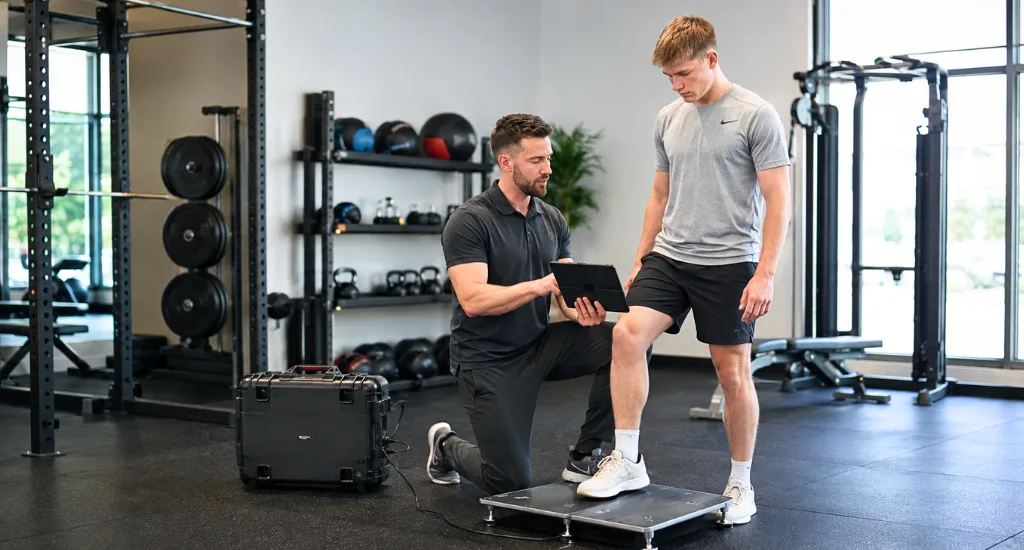
Not sure whether your current program covers these seven markers? Ask your clinic for your latest strength symmetry numbers. If they cannot produce them, that answer tells you a lot.
The Phases of an Advanced Sports Rehab Program
Advanced sports rehabilitation moves through five phases, and each one has an exit test rather than an end date.
| Phase | Typical Window | Goal | What Advanced Programs Add |
| 1. Acute care | Days 1-5 | Control pain and swelling, protect the tissue | Keep the rest of the body training |
| 2. Mobility | Days 5-21 | Restore full pain-free range of motion | Movement quality screening |
| 3. Strength | Weeks 3-12 | Rebuild force, power, and load tolerance | Dynamometry, eccentric loading, blood flow restriction |
| 4. Coordination | Weeks 6 and beyond | Restore proprioception and neuromuscular control | Reactive and unstable-surface drills |
| 5. Return to sport | Criteria-based | Meet full competitive demands | Return-to-sport test battery and clearance |
Physiopedia frames good rehabilitation around seven principles, summarized by the mnemonic ATC IS IT: avoid aggravation, timing, compliance, individualization, specific sequencing, intensity, and total patient. Advanced programs apply all seven, and the last one matters most. Treating the total patient means the athlete keeps training while the injury heals.
Signs Your Current Rehab Program Isn’t Advanced
Seven red flags suggest your program is general physical therapy with a sports label:
- No one has objectively tested your strength or left-to-right symmetry.
- Your exercise sheet looks identical to the person on the next table.
- Nobody asked which sport you are returning to or set goals with you.
- Progression happens by week number, not by passing anything.
- Sessions are mostly passive: heat, stim, and table time.
- Discharge is scheduled because visits ran out, not because you passed a test.
- Your sport’s actual movements have never appeared in a session.
Switching clinics mid-rehab is common and reasonable. Athletes on r/ACL frequently describe a first therapist who focuses on daily function rather than return to sport, followed by better results after moving to a sports-focused provider. You are allowed to ask for a second opinion.
How to Choose an Advanced Sports Rehabilitation Program
Credentials that actually mean something
Credentials are the fastest way to separate an advanced sports rehab clinic from a general one. Every new physical therapist holds a DPT, so that alone doesn’t signal anything special. The Sports Certified Specialist (SCS) credential from the American Board of Physical Therapy Specialties requires advanced training, clinical hours, and a rigorous exam. The Certified Strength and Conditioning Specialist (CSCS) certification from the National Strength and Conditioning Association demonstrates expertise in performance training. Sports residencies and fellowships add further depth.
Five questions to ask before you book
- Ask how you will measure my strength and symmetry, and how often.
- Ask which specific criteria I must pass to be cleared for my sport.
- Ask whether my program will include the actual movements of my sport.
- Ask what happens if my insurance visits end before I am cleared.
- Ask whether you coordinate with my surgeon, coach, or trainer.
Clear answers signal a real program. Vague answers signal a general clinic.
Frequently Asked Questions
What is advanced rehabilitation?
Advanced rehabilitation is care that goes beyond pain relief and basic function to restore full performance, using objective testing and criteria-based progression. It is measured, sport-specific, and built around return-to-sport benchmarks rather than a fixed timeline.
What are the 5 phases of rehab progression in sports?
The five phases of rehab progression in sports are acute care and pain control, mobility and range of motion, strength and load tolerance, coordination and proprioception, and return to sport. Advanced programs attach a passing test to each phase.
How long does an advanced sports rehabilitation program take?
An advanced sports rehabilitation program takes anywhere from a few weeks to over a year, depending on the injury. Nowak Orthopedic Associates cites 1 to 3 weeks for a mild hamstring strain and 10 to 15 months for ACL reconstruction, with a median return to sport near 292 days.
Is advanced sports rehab covered by insurance?
Advanced sports rehab is usually covered by insurance when billed as physical therapy, though most plans cap the number of visits per year. Performance testing and late-stage return-to-sport training are sometimes offered as cash-pay packages. Ask for both costs before you start.
Do I need to be a competitive athlete to benefit?
No, you do not need to be a competitive athlete to benefit from advanced sports rehabilitation. Recreational runners, cyclists, pickleball players, and adults over 40 gain the most from measured clearance because their injuries often result from load and movement faults that generic programs never test for.
End Note
The real difference comes down to one question: can your clinic prove you are ready? An advanced sports rehabilitation program answers that question with test scores, sport-specific training, and clear benchmarks rather than a discharge date.
If your current plan cannot show you those numbers, ask for a return-to-sport assessment. Getting cleared should feel like passing a test, not running out of appointments.