


Most first-time shoulder dislocations treated without surgery take about 12 to 16 weeks to feel normal again. A return to contact or throwing sports usually lands somewhere between 3 and 6 months. If you need surgery, plan on 4 to 6 months or more before full clearance. The tricky part is that your shoulder will feel better long before it is truly stable, and that gap is where most re-injuries happen. If you are dealing with a fresh dislocation, our shoulder pain treatment in Cherry Hill is built to close that gap safely.
Shoulder Dislocation Recovery Time at a Glance
Your shoulder dislocation recovery period depends on the injury, but most people follow a similar path. Here is what a typical first dislocation looks like:
|
Stage |
Typical timing |
| Sling or immobilizer | 1 to 3 weeks |
| Gentle range of motion | Starts in weeks 1 to 3 |
| Desk work and daily tasks | 1 to 4 weeks |
| Light lifting and gym work | 6 to 12 weeks |
| Swimming and non-contact sports | 8 to 16 weeks |
| Throwing and contact sports (no surgery) | 3 to 6 months |
| Full recovery after surgery | 4 to 6 months or more |
| Total treatment time (sling plus PT) | About 3 to 4 months |
Treat these numbers as ranges, not deadlines. Milestones decide when you move forward.
What Affects How Long Your Shoulder Takes to Heal
Two people with the same injury can recover on very different schedules. These factors matter most:
- Age: Younger athletes heal quickly but re-dislocate far more often.
- First or repeat dislocation: Each dislocation stretches the ligaments a little more.
- Partial or full dislocation: A subluxation (partial slip) usually recovers faster.
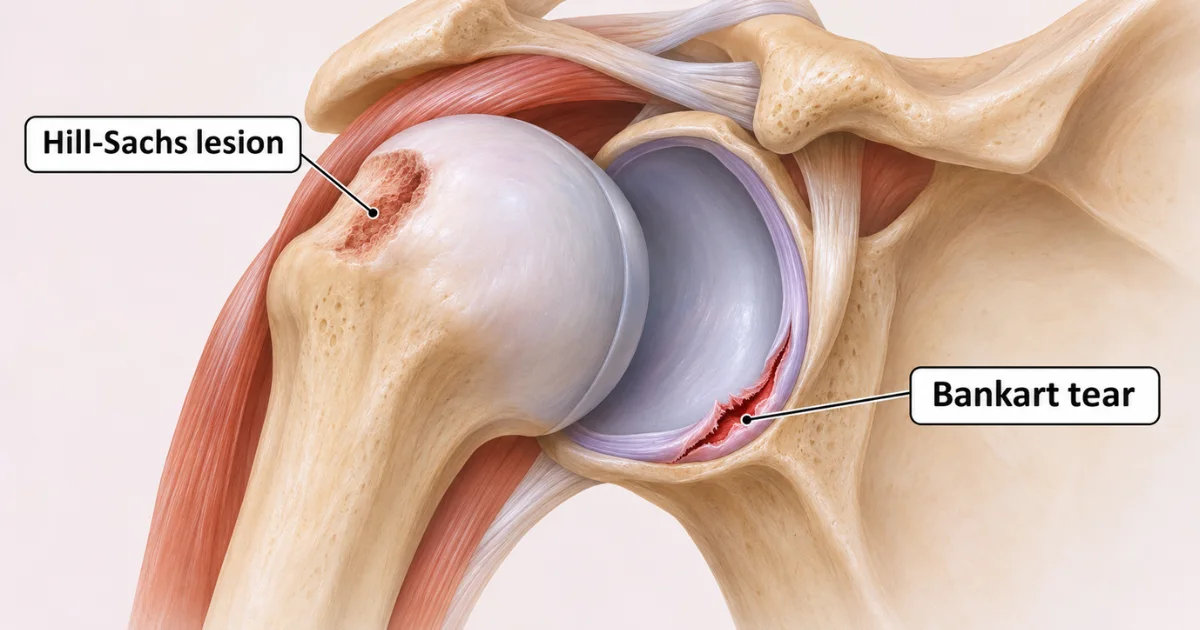
- Extra damage: A labral (Bankart) tear, a Hill-Sachs lesion, a fracture, or a rotator cuff tear adds time.
- Sport demands: Overhead and contact athletes need more strength and control.
- Rehab consistency: Following your plan is the biggest factor you control.
Shoulder Dislocation Recovery Timeline Without Surgery
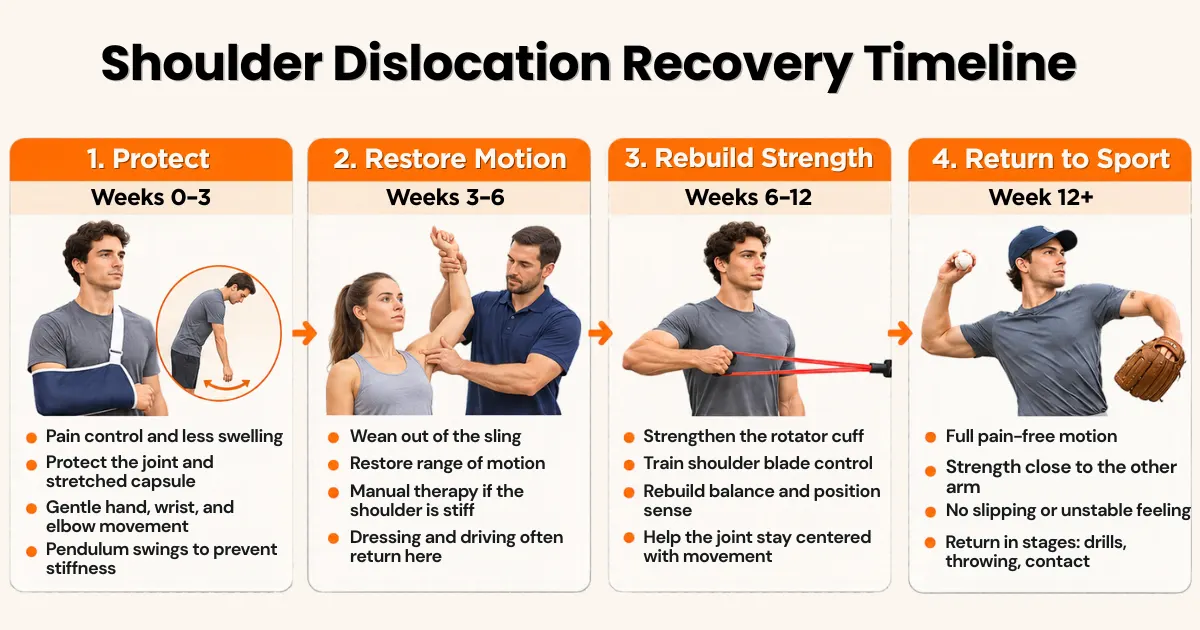
For most first-time dislocations, shoulder dislocation rehab time runs about 8 to 12 weeks of physical therapy. A good recovery protocol moves you forward based on what your shoulder can do, not just the date on the calendar.
Weeks 0 to 3: Protect and Calm the Joint
Your sling does the heavy lifting here. The goals are pain control, less swelling, and protecting the stretched capsule. Gentle hand, wrist, and elbow movement, plus pendulum swings, keep stiffness from setting in.
Weeks 3 to 6: Restore Range of Motion
You start weaning out of the sling and working on motion with your therapist’s help. If the joint has stiffened, hands-on manual therapy helps restore movement without stressing the front of the shoulder. Most daily tasks like dressing and driving return in this window.
Weeks 6 to 12: Rebuild Strength and Control
Now the work shifts to the rotator cuff and the muscles that control your shoulder blade. Balance and position-sense drills teach the shoulder to stay centered when you move fast or get bumped.
Week 12 and Beyond: Return to Sport Milestones
You are ready for full sport when you have full, pain-free motion, strength close to your other arm, and no “about to slip” feeling in risky positions. Sport drills, throwing progressions, and contact work come back in stages. Watch for warning signs along the way: a slipping or catching feeling, new partial dislocations, weakness that does not improve, or numbness in the arm. Any of these means your plan needs a closer look before you push harder.
Shoulder Dislocation Recovery Time After Surgery
Surgery usually means an arthroscopic Bankart repair, which reattaches the torn labrum and tightens the capsule. If bone is missing from the socket, a surgeon may recommend a Latarjet procedure instead.
After surgery, shoulder dislocation recovery time typically looks like this: about 4 to 6 weeks in a sling, motion work through the first 3 months, and strength training after that. Most athletes return to non-contact sports around 4 to 6 months, and contact athletes often need closer to 6 months. Our labrum repair recovery timeline breaks down each week in detail. A structured post-surgical rehabilitation plan protects the repair while you rebuild strength.
Rehab First or Surgery? How the Decision Gets Made
Most first dislocations start with rehab. Surgery becomes the better choice when the odds of another dislocation are high.
| Rehab first |
Surgery |
|
| Best for | First dislocation, non-contact athletes, adults over 30 | Young contact athletes, repeat dislocations, bone loss |
| Return to sport | Weeks to about 4 months | About 4 to 6 months |
| Re-dislocation risk | Higher, especially in teens | Much lower |
| Trade-off | Faster return, more risk | Longer recovery, more stability |
Age drives the decision. After a first dislocation, recurrence is about 72 percent in ages 12 to 22, about 56 percent in ages 23 to 29, and about 27 percent after 30. A second dislocation, a large labral tear, or bone loss usually tips the decision toward surgery.
Dislocated Shoulders in Athletes: Return-to-Play Timelines
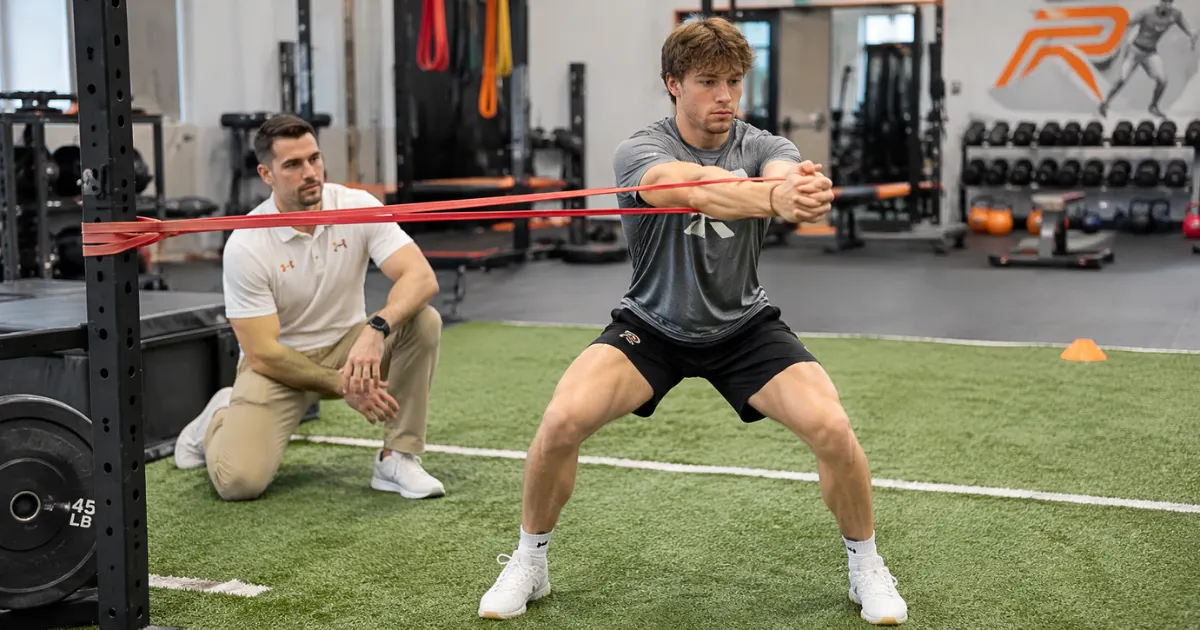
Dislocated shoulders in athletes are common in football, hockey, wrestling, and lacrosse, and in overhead sports like volleyball, swimming, and baseball. If you play above your head, our guide to shoulder injuries in volleyball explains why overhead athletes are at extra risk.
Can You Finish the Season Without Surgery?
Sometimes. In one study of college contact athletes, about 73 percent returned the same season after missing a median of just 5 days. The catch is that many re-dislocated, and about half of athletes in similar studies needed surgery after the season. A brace can help you return, but it does not remove that risk.
What Pro Athletes Show Us
NFL data is a useful benchmark. Players treated without surgery usually return in about 4 to 6 weeks, while surgery takes about 5 to 6 months. Surgically treated players had about 23 percent fewer repeat injuries. Pro rugby league (NRL) and Australian football (AFL) teams follow a similar split between a quick return and a season-ending repair. Pros have daily medical care, so they are not the right yardstick for most amateur athletes. Rushing back is a big reason why sports injuries keep coming back.
Dislocated Shoulder in a Young Athlete: What Parents Should Know
A dislocated shoulder in a young athlete carries the highest risk of happening again. Teens in contact sports can see recurrence rates of up to 90 percent. Young bodies heal fast, so kids often feel ready to play long before the shoulder can handle a hit. Here is what parents should know:
- Get imaging: An MRI shows labral tears or bone damage an X-ray can miss.
- Plan for a second dislocation: Ask your doctor what happens if it slips again.
- Avoid rushing for one big game: A second dislocation can mean more damage and surgery.
- Ask for return-to-play testing: Strength and stability tests beat “it feels fine.”
- Coordinate with the school: Share the plan with coaches, the athletic trainer, and the PE teacher.
Shoulder Dislocation Recovery Exercises by Phase
The right shoulder dislocation recovery exercises change as you heal. Your therapist will match them to your stage:
- Pendulum swings (weeks 0 to 3) keep the joint moving without strain.
- Isometric holds (weeks 1 to 4) wake up the rotator cuff with no movement.
- Scapular squeezes (weeks 1 to 6) train your shoulder blade to support the joint.
- Band rotations (weeks 6 to 12) strengthen the rotator cuff in a safe range.
- Wall slides (weeks 4 to 8) rebuild overhead motion with control.
- Rhythmic stabilization (weeks 8 to 12) teaches the shoulder to react to quick forces.
- Push-up plus (weeks 10 and beyond) builds strength for contact and weight bearing.
Blood flow restriction training can help you build muscle with light loads while the joint is still protected.
Shoulder Dislocation Exercises to Avoid
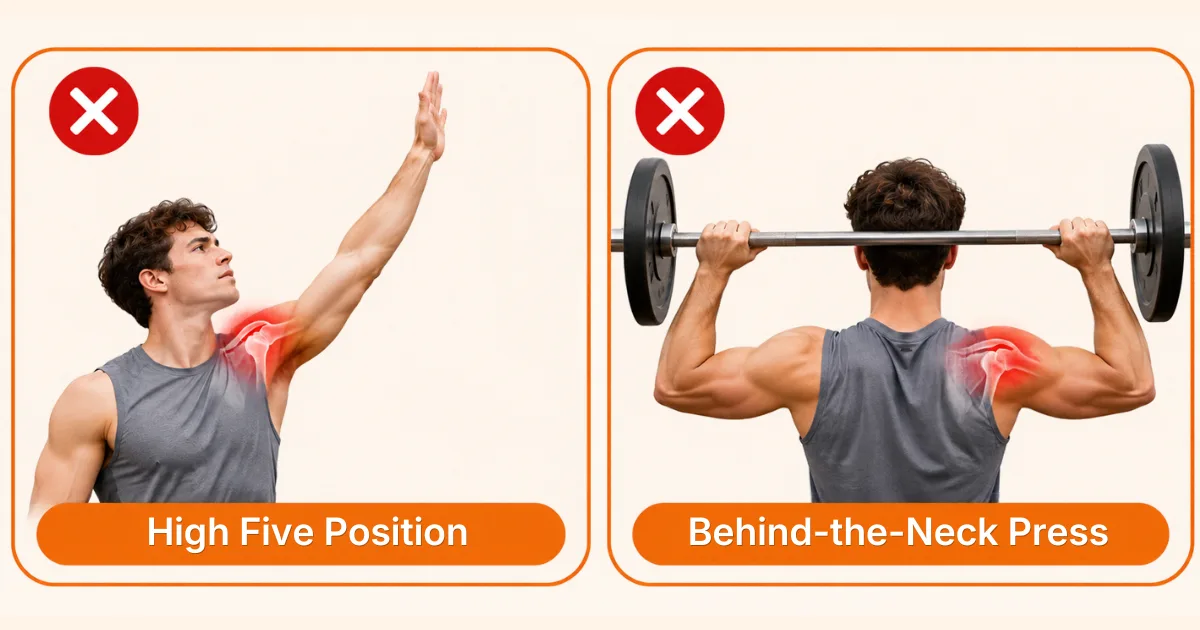
Some shoulder dislocation exercises to avoid put the joint in the exact position it slipped out of. Until your therapist clears you, skip these:
- Arm out to the side and rotated back, like a high-five or throwing position
- Behind-the-neck presses and lat pulldowns
- Deep dips
- Heavy wide-grip bench press
- Kipping pull-ups and other swinging movements
- Heavy overhead lifting in the first few months
Get Back to Your Sport With Rehabletics in Cherry Hill
Your recovery deserves a plan built around your sport. At Rehabletics, Dr. Jaime Mor, PT, DPT, ATC, guides athletes from the sling to full clearance with one-on-one care. Explore our sports injury rehab program, or book a free call to map out your return.