


An ACL injury rehab program is a phased plan, led by a physical therapist, that takes you from the first days after a tear or surgery all the way back to full sport. Most athletes need about 9 to 12 months after reconstruction before they are ready to cut, pivot, and compete again. The calendar is only a guide, though. What actually moves you forward is meeting clear strength, motion, and movement goals at each stage.
That difference matters. Athletes who rush back on a date instead of on results reinjure their knees at far higher rates. A well-built program protects your new ligament early, rebuilds strength in the middle, and then retrains your body to jump, land, and change direction with confidence.
At Rehabletics in Cherry Hill, NJ, Dr. Jaime Mor, PT, DPT, ATC, and our team guide athletes through every step of ACL rehab with our sports physical therapists, from the first quad set to the first full game back.
Here is the roadmap at a glance:
- Phase 1, Protect and Restore: calm swelling, straighten the knee, and wake up the quad.
- Phase 2, Rebuild Strength: load the leg, regain full motion, and walk and move normally.
- Phase 3, Run, Jump, and Land: add running, plyometrics, and deceleration control.
- Phase 4, Return to Sport: train cutting, pivoting, and game speed, then pass testing.
What Is an ACL Injury Rehab Program?
An ACL injury rehab program is a structured series of exercises, hands-on treatment, and testing that restores the knee’s motion, strength, control, and your trust in it. It is not a single sheet of exercises. It is a progression that changes as your knee heals and your body adapts.
The anterior cruciate ligament (ACL) is one of the main stabilizers inside your knee. It keeps the shinbone from sliding forward and controls rotation. That is why most ACL tears happen without contact, during a sudden cut, a pivot on a planted foot, or an awkward landing from a jump. Soccer, basketball, football, lacrosse, and volleyball players are especially exposed.
Good ACL physical therapy usually blends several pieces:
- Manual therapy to restore joint and kneecap mobility.
- Progressive strength training for the quads, hamstrings, hips, and calves.
- Neuromuscular training for balance, landing, and reaction.
- Objective testing to decide when you are ready for the next phase.
Your physical therapist also coordinates with your surgeon, tracks swelling and motion every visit, and adjusts the plan to your sport. To see how we approach the injury itself, from first evaluation to return to play, read about how we treat ACL injuries. If your knee problem is a different structure, such as the meniscus or patellar tendon, our guide to rehab programs for other knee injuries is a helpful next read.
Who Needs an ACL Rehab Program?
Anyone with an ACL injury benefits from a guided program, but the plan looks different for each situation:
- ACL sprain (grade 1 or 2): The ligament is stretched or partly torn but still works. Rehab focuses on strength and stability.
- Partial tear: Some fibers are torn. Many people do well with physical therapy alone, depending on stability and sport.
- Complete tear: The ligament is fully torn. ACL tear physical therapy may come before surgery, after it, or replace it in some cases.
- After reconstruction or revision: The classic ACL tear rehab program, built around protecting and loading the new graft.
- ACL plus meniscus or cartilage injury: Early steps move more slowly to protect the repair.
Whatever your starting point, the goal of an ACL tear recovery program is the same: a stable knee you can trust in sport and daily life.
Surgery or No Surgery: Choosing Your ACL Rehab Path
Not every ACL injury needs surgery. The right path depends on how stable your knee feels, which sport you play, your age, and any other damage inside the joint. Your surgeon and physical therapist should make this decision with you.
| Factor | Rehab After Reconstruction | Rehab Without Surgery |
| Best fit | Cutting and pivoting athletes, unstable knees, young athletes | Lower-demand sports, partial tears, stable knees |
| Main goal | Protect the graft, then rebuild full sport function | Build muscle control so the knee stays stable without a ligament |
| Typical length | 9 to 12 months to return to sport | About 3 to 6 months, sometimes longer |
| Watch for | Stiffness, quad weakness, returning too early | Repeated giving way, new meniscus damage |
If you choose surgery, your graft type also shapes your rehab. The most common options are the patellar tendon, the hamstring tendons, the quadriceps tendon, or a donor graft. Each one has its own early precautions. For example, a hamstring graft limits early hamstring loading, while a patellar tendon graft can make kneeling sore for a while. Your therapist will build the plan around the graft you have.
Prehab Before ACL Surgery
Prehab is rehab before surgery, and it may be one of the smartest investments you can make. The goals are simple: calm swelling, get the knee fully straight, keep the quads strong, and stay fit. Athletes who walk into surgery with a quiet, straight, strong knee tend to recover motion and strength faster afterward. Our pre-surgical rehabilitation program typically includes quad activation, gentle range of motion work, balance training, and bike conditioning in the weeks before your procedure.
Rehab Without Surgery
Physical therapy is a real ACL treatment option, not just a step before surgery. People who do well without reconstruction are often called “copers.” They have little giving way and play sports with less cutting, such as running, cycling, or swimming. ACL sprain rehabilitation follows a similar path: restore motion, build quad and hamstring strength, and train balance and landing control.
The warning sign is instability. If your knee keeps buckling during daily tasks or sport, that repeated slipping can damage the meniscus and cartilage. In that case, it is time to talk with your surgeon about reconstruction.
ACL Rehab Timeline at a Glance
A typical ACL rehab timeline after reconstruction runs 9 to 12 months, with key milestones along the way. Use this table as a guide, and remember that each milestone has a requirement that must come first.
| Milestone | Typical Timing | What Must Be True First |
| Rehab begins | Day of surgery or within a few days | Cleared by your surgeon |
| Crutches off | About 1 to 2 weeks | Normal walking pattern without a limp |
| Driving | About 2 weeks for a left knee, often longer for a right knee | Off pain medication, quick and safe braking |
| Full knee motion | About 8 to 12 weeks | Full extension kept from day one |
| Jogging | About 3 to 4 months at the earliest | Quad strength near 80 percent, no swelling |
| Jumping and landing drills | About 4 to 6 months | Good single-leg control |
| Cutting and pivoting | About 6 to 9 months | Strong hop and landing scores |
| Return to sport | 9 months or later | Passing return-to-sport testing |
Graft type, a meniscus repair, and your sport can all shift these numbers. For a closer look at healing time with and without surgery, see our guide on how long a torn ACL takes to heal.
The Phases of ACL Rehabilitation
The phases of ACL rehabilitation overlap, and you move up when you pass each gate, not when a certain week arrives. An ACL surgery rehab program usually has four phases. Each one has its own goals, its own exercises, and its own checklist before you progress.
Phase 1: Protect and Restore (Weeks 0 to 2)
Goals: control swelling, get the knee fully straight, wake up the quad, and walk safely.
The first two weeks set the tone for your whole recovery. The biggest priority is full knee extension. A knee that cannot fully straighten leads to a limp, front-of-knee pain, and stiffness that is hard to fix later. Bending matters too, but straightening comes first.
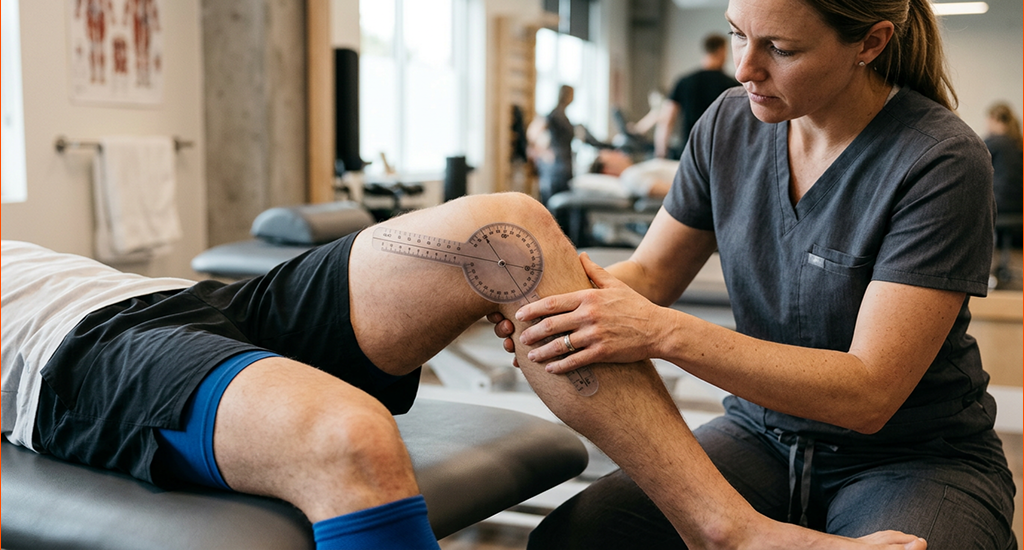
Swelling is your other main focus. Ice, compression, and elevation help, and our cold therapy for swelling can calm a stubborn, puffy knee. Your therapist will also use hands-on manual therapy to keep the kneecap moving and the incisions supple once they heal.
Phase 1 ACL rehab exercises include:
- Heel props: rest your heel on a rolled towel and let the knee sag straight for 5 to 10 minutes.
- Quad sets: tighten the thigh and press the back of the knee down, many times a day.
- Straight leg raises: lift the leg only once you can keep the knee fully locked.
- Heel slides: slide the heel toward you to build bend gently.
- Ankle pumps and glute squeezes: keep blood moving and hips active.
- Stationary bike: start with rocking half circles, then full pedal strokes.
Many athletes find that the quad simply “will not fire” after surgery. This is called arthrogenic muscle inhibition. Swelling and pain shut the muscle down as a protective reflex. Neuromuscular electrical stimulation (NMES) can help switch it back on.
A common worry is that bending the knee will tear the new graft. When you follow your surgeon and therapist’s limits, gentle motion is safe and necessary.
Move on when: your knee straightens fully, you can do a straight leg raise without the knee bending, swelling is controlled, and you walk without a limp.
Phase 2: Rebuild Strength and Normal Movement (Weeks 2 to 12)
Goals: reach full range of motion, rebuild muscle, and restore balance and normal daily movement.
This is where the real strength work begins. By about 4 weeks after ACL surgery, most athletes are off crutches and ready for exercises such as:
- Mini squats and wall sits in a pain-free range.
- Step-ups onto a low box.
- Leg press with both legs, then one.
- Bridges for the glutes and hamstrings.
- Single-leg balance on firm ground, then on foam.
- Full revolutions on the bike with light resistance.
As the weeks go on, phase 2 ACL rehab exercises get heavier and more challenging. Split squats, step-downs, hamstring sliders, calf raises, side planks, and the Copenhagen plank build the whole leg and trunk. Heavier loads are what reverse the muscle loss after surgery, so your therapist will push you more each week once your knee tolerates it.
Lifting heavy is hard early, while the graft is still maturing. That is where blood flow restriction training helps. A cuff on the upper thigh lets light weights produce strength gains similar to heavier lifting, which limits early atrophy.
Your graft and any extra procedures shape this phase. A hamstring tendon graft means hamstring curls build slowly. A meniscus repair often limits deep squats and weight bearing for several weeks. Keep training your other leg and upper body too, so you do not lose fitness elsewhere.
Move on when: you have full motion, quad strength is about 70 to 80 percent of your other leg, you can do a controlled single-leg squat, and the knee stays calm after workouts.
Phase 3: Running, Jumping, and Landing Control (Months 3 to 6)
Goals: return to running, build power, and learn to land and slow down safely.
Running is the milestone most athletes circle on the calendar. It should depend on criteria, not a date. Common running gates include quad strength of at least 80 percent of the other leg, full extension, no swelling, and good single-leg squat quality. Running starts with walk and jog intervals on flat ground, then builds in time and speed.
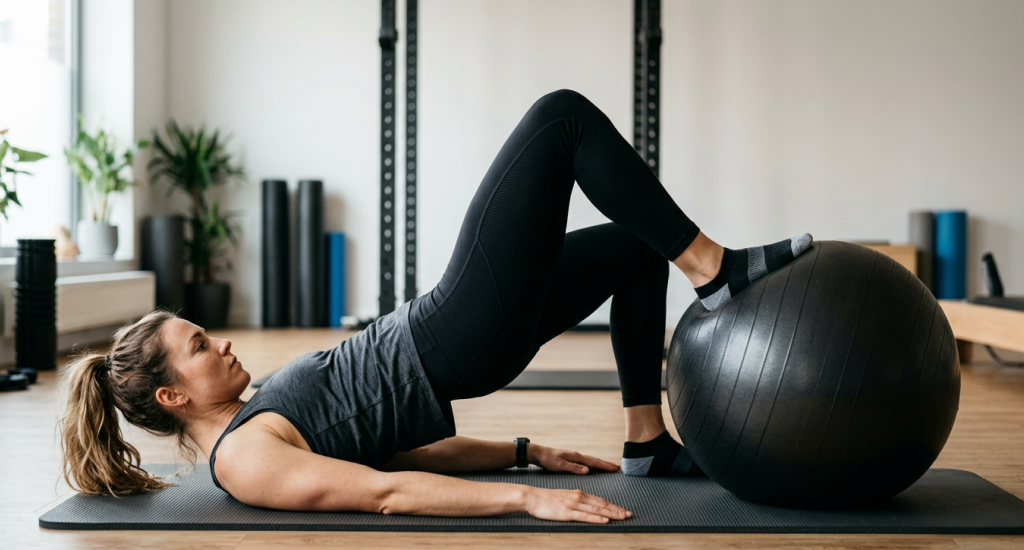
Phase 3 ACL rehab exercises follow a jumping ladder. You master each step before the next:
- Double-leg landings from a low box.
- Double-leg jumps in place, forward, and side to side.
- Single-leg landings with the knee tracking over the toes.
- Single-leg hops forward, sideways, and with turns.
Deceleration work matters just as much as speed. Many ACL injuries happen while stopping, not while running. Step-and-stick drills, lunge stops, and run-to-stop drills teach your quads and hips to absorb force. Strength work stays heavy, with more single-leg exercises and power moves such as jump squats.
Move on when: you land softly on one leg with good knee control, show no swelling after impact days, and pass early hop and strength checks.
Phase 4: Sport-Specific Training and Return to Play (Months 6 to 12)
Goals: rebuild agility, cutting, and reaction speed, then return to competition step by step.
Now training starts to look like your sport. Agility ladders, cone drills, planned cuts, and then reactive cuts to a coach’s signal train the exact movements that injured you. A soccer player works on dribbling and change of direction. A basketball player works on defensive slides and landing after rebounds.
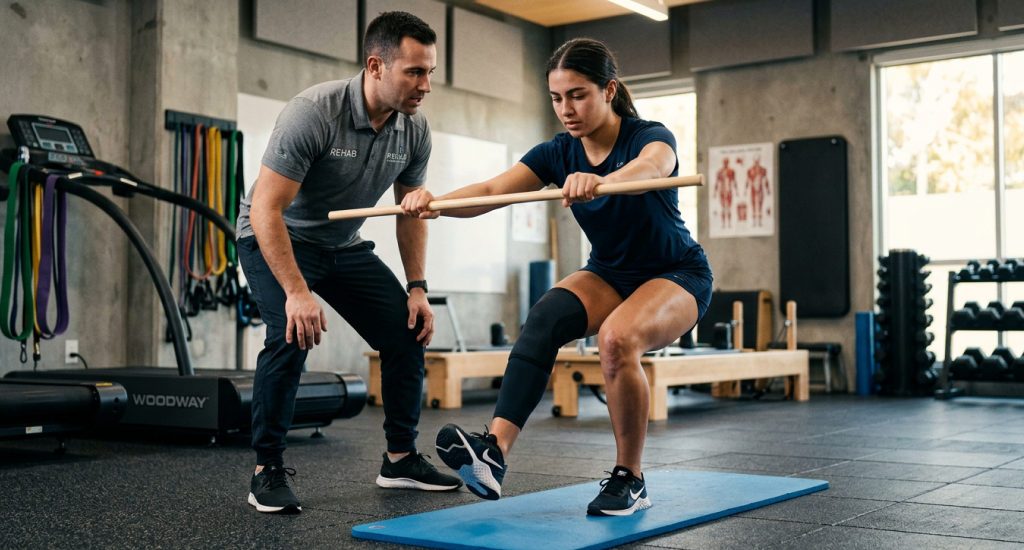
Returning to the field should be gradual too:
- Non-contact practice
- Small-sided or limited contact drills
- Full practice
- Games with limited minutes
- Full, unrestricted competition
Each step should feel stable, without pain, swelling, or hesitation.
Confidence is part of this phase too. Many athletes feel physically ready but still hesitate on a hard cut or a contested landing. That hesitation is normal, and it improves with exposure. Practicing game situations in a controlled setting, with gradually rising intensity, helps your brain trust the knee again. If fear stays high, tell your therapist so the plan can include more reactive drills before you compete. Your program does not really end at clearance. A regular injury prevention warm-up and two strength sessions a week help protect both knees for years.
Best Exercises for ACL Rehab
The best exercises for ACL rehab are the ones that match your current phase. A movement that is perfect in month four can be too much in week two. Here are the most effective choices for each stage.
| Phase | Top Exercises | What They Build |
| Phase 1 | Quad sets, straight leg raises, heel slides, heel props | Quad activation, full extension, early bend |
| Phase 2 | Leg press, split squats, step-downs, hamstring sliders, calf raises | Muscle strength and knee control |
| Phase 2 to 3 | Single-leg RDL, Copenhagen plank, Y balance reaches | Hip strength, balance, trunk control |
| Phase 3 | Box landings, jump squats, single-leg hops, lunge stops | Power, landing, deceleration |
| Phase 4 | Cone cuts, reactive agility, sport drills | Speed, reaction, sport skills |
These ACL tear exercises to rehabilitate the knee also work for non-surgical rehab, with progress based on stability instead of graft healing.
A mid-rehab ACL rehab exercise program often looks like this sample week:
- Monday, Wednesday, Friday: a strength workout of 4 to 6 exercises, such as leg press, split squats, hamstring curls, single-leg RDLs, calf raises, and a core move.
- Tuesday and Thursday: 20 to 40 minutes on the bike plus balance drills.
- Every day: 10 minutes of knee mobility and quad sets.
Treat this ACL injury recovery workout as an example, not a prescription. Your therapist will set the sets, reps, and load for your knee. For detailed form tips and progressions, see our step-by-step ACL exercise guide.
What to Expect at Physical Therapy After ACL Surgery
Physical therapy after ACL surgery usually starts within the first few days. At the first visit, your therapist measures swelling, knee motion, quad activation, and how you walk. You leave with a short home program you will do several times a day.
A typical session follows a steady rhythm. It starts with a check of swelling and motion, moves into hands-on work and mobility, then strength and balance training, and ends with a review of your home exercises. Early on, many athletes attend two to three times per week. As you become more independent, visits may drop, but they never become less important. Later visits focus on running, jumping, and testing.
Progress is tracked with numbers, not just feel. Expect your therapist to measure knee bend and straightening with a goniometer, test quad strength, and watch how you squat, step down, and land. These checks show you how far you have come, which is a big help on days when progress feels slow.
Our post-surgical rehabilitation program is built around this rhythm, with each session adjusted to your progress. If you are new to sports physical therapy, here is what happens during your first sports physical therapy visit.
Some soreness after sessions is normal. It should settle within a day. Call your surgeon or therapist right away if you notice any of these:
- Swelling that keeps increasing
- The knee giving way
- Calf pain, warmth, or swelling
- Fever, or redness or drainage at an incision
What Is the Best Rehab Protocol After ACL Surgery?
The best rehab protocol after ACL surgery is criteria-based. It uses fixed time limits only to protect healing tissue, and it moves you forward when you meet measurable goals. It should also be adjusted to your graft type, any extra repairs, your sport, and your surgeon’s guidance.
| Approach | Pros | Cons |
| Time-based protocol | Simple to follow, clear dates | Ignores how your knee is actually doing; may rush or hold you back |
| Criteria-based protocol | Matches your real progress, lowers reinjury risk | Requires regular testing and a skilled therapist |
Older ACL injury rehab protocols often cleared athletes for sport at 6 months. Research has since shown that this is too early for most athletes. In one well-known study, each month athletes delayed their return up to 9 months after surgery cut their reinjury rate by about 51 percent. That is why most modern ACL surgery rehab protocols blend a minimum time frame with objective testing.
When you compare programs, look for a few key features. A strong protocol starts motion and quad work right away, sets clear gates for running and jumping, includes heavy strength training rather than only light band work, trains landing and deceleration, and finishes with formal return-to-sport testing. If a program skips any of these, ask why.
Return-to-Sport Testing: How You Know You Are Ready
You are ready for sport when your injured leg performs almost as well as your other leg, your movement is clean under fatigue, and you feel confident. Testing replaces guesswork with numbers.
| Test | Passing Target |
| Quadriceps and hamstring strength | 90 percent or more of the other leg |
| Single-leg hop tests (distance, triple, crossover, timed) | 90 percent or more of the other leg |
| Vertical jump and landing quality | Even force between legs, controlled knee position |
| Agility and cutting | Clean technique at game speed |
| Conditioning | Able to finish full practice without fading |
| Psychological readiness (ACL-RSI) | High confidence, low fear of reinjury |
Tools like force plate testing measure how much force each leg produces and absorbs. That can reveal hidden imbalances that a hop test alone may miss.
Here is why testing is worth it. Research shows that only about 55 percent of athletes return to competitive sport after ACL reconstruction. About 1 in 4 young athletes under 25 who return to high-risk sports suffer a second ACL injury. In the same study cited above, athletes who passed return-to-sport criteria had a reinjury rate of 5.6 percent, compared with 38.2 percent for those who did not.
Testing is not a one-time event. Most athletes test several times, often around 3, 6, and 9 months, so you can see trends and target weak spots. If you fall short on one test, that simply tells your therapist what to train next.
Common ACL Rehab Mistakes That Slow Your Recovery
Most setbacks in ACL rehab come from a handful of avoidable mistakes:
- Chasing bend before straightening: losing extension early causes a limp and knee pain.
- Skipping quad work: a weak quad is the most common reason athletes stall.
- Doing too much, too soon: more sets are not always better; a swollen knee needs less load.
- Ignoring swelling: swelling after a workout means the dose was too high.
- Running before you are ready: sore, puffy knees and early running do not mix.
- Returning by the calendar: a date is not a test.
- Ignoring the mental side: fear of reinjury is common and trainable.
- Stopping strength work after clearance: strength fades fast without upkeep.
If you have been through an injury before, our article on why sports injuries keep coming back explains the hidden factors behind repeat problems. If you are dealing with lingering knee pain months after surgery, a full reassessment can find what is holding you back.
How Rehabletics Runs ACL Rehab in Cherry Hill, NJ
Rehabletics is a sports physical therapy clinic at 5 Esterbrook Lane in Cherry Hill, NJ, founded by Dr. Jaime Mor, PT, DPT, ATC. Dr. Mor is a licensed physical therapist and certified athletic trainer who has worked with athletes since 2013. Our team also serves as a sports physical therapy contractor for the Philadelphia Flyers and Philadelphia Eagles.
Our ACL program is built for athletes and active adults who want more than a basic exercise sheet:
- One-on-one sessions with a Doctor of Physical Therapy.
- Criteria-based phases with clear goals at every step.
- Advanced tools, including BFR, NMES, manual therapy, and force plate testing.
- Sport-specific training that reflects how you actually play.
This is the same athlete-first approach we bring to all sports injury care in Cherry Hill. You do not need a referral to start. New Jersey allows direct access physical therapy in NJ, so you can book with us directly. We work with athletes from across South Jersey, including families and athletes from Voorhees, Haddonfield, Marlton, and Moorestown.
Start Your ACL Comeback With a Plan
An ACL injury can feel like the end of your season, but with the right plan, it is the start of a stronger comeback. Every phase has a purpose, every milestone has a test, and every step brings you closer to playing with confidence again. Our team in Cherry Hill is ready to guide you from day one to game day. Book a free consultation today, and let’s build your path back to the sport you love.