


Hamstring Injury Treatment and Recovery in Cherry Hill, NJ

Treatment Modalities
Athlete-First Approach
One second you’re sprinting for the ball. The next, there’s a sharp grab at the back of your thigh and you’re pulling up short. A pulled hamstring stops athletes in their tracks, and the bigger worry is whether it will happen again the moment you get back to full speed. The good news: most hamstring injuries heal well with the right plan. At Rehabletics, our hamstring injury treatment combines one-on-one physical therapy, hands-on care and progressive strength work to help you recover fully and return to your sport with confidence. Dr. Jaime Mor, PT, DPT, ATC, and our team work with athletes and active adults across South Jersey.
What Is a Hamstring Injury?
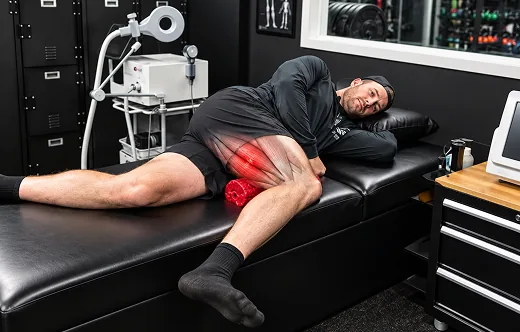
A hamstring injury is a strain or tear in one or more of the three muscles that run down the back of your thigh. It happens when the muscle is stretched or loaded beyond what it can handle, usually during sprinting, kicking or a sudden change of speed. Injuries range from a mild pull to a complete tear.
Meet Your Hamstring Muscles
Your hamstring muscles are the biceps femoris, the semitendinosus and the semimembranosus. Together they start at your sit bone (the bottom of the pelvis), run down the back of the thigh and attach just below the knee. They bend your knee, extend your hip and act as brakes when your leg swings forward during a sprint. That braking job is exactly why they get hurt so often in fast, explosive sports.
Pulled Hamstring, Strain, Sprain or Tear: What’s the Difference?
People use these words interchangeably, so here’s a quick guide:
- Pulled hamstring is the everyday term for a hamstring strain.
- Strain means the muscle or tendon fibers were overstretched or torn.
- Tear describes a more serious strain where a larger part of the muscle, or all of it, has torn.
- Sprain technically refers to a ligament, not a muscle. When people search for hamstring sprain treatment, they almost always mean a strain, and the care is the same.
Common Thigh Muscle Injury Types
The back of the thigh isn’t the only area that takes a beating. The most common thigh muscle injury types include hamstring strains (back of the thigh), quadriceps strains (front of the thigh), groin or adductor strains (inner thigh) and thigh contusions, the deep bruises from a direct hit. Each one needs a slightly different rehab plan, which is why a proper evaluation matters.
Grades of Hamstring Injuries
Hamstring strains are graded by how much of the muscle is damaged:
- Grade 1 (mild strain): A small number of fibers are overstretched or torn. You feel tightness or a pulling sensation but can usually walk normally.
- Grade 2 (partial tear): A larger portion of the muscle is torn. Expect noticeable pain, weakness, swelling and often a limp.
- Grade 3 (severe or complete tear): The muscle or tendon is fully torn, sometimes pulling away from the bone. Walking is difficult, and some cases need a surgical consult.
Pulled Hamstring Symptoms
Hamstring injury symptoms usually show up the moment it happens. Watch for:
- Sudden, sharp pain in the back of the thigh or buttock
- A popping or snapping feeling at the time of injury
- Swelling and tenderness within the first few hours
- Bruising that appears over the next day or two
- Weakness or pain when you bend your knee or lift your leg behind you
- Muscle spasms or cramping
- Pain or difficulty walking, sitting or straightening the knee
The more severe the strain, the stronger these signs tend to be.
Why Do I Have Pain in My Knee and Back of My Thigh?
Your hamstrings attach just below the knee, so a strain near the lower end of the muscle often causes pain in the knee and back of the thigh at the same time. That pattern can also point to a hamstring tendon problem, a calf issue or pain coming from the knee joint itself. If you’re not sure where the pain is really coming from, an evaluation helps sort it out. Our knee pain treatment team looks at the whole leg, not just the sore spot.
Hamstring Tendonitis and Hamstring Tendinopathy
Not every hamstring problem starts with a sudden pull. Hamstring tendonitis, more accurately called hamstring tendinopathy, is an overuse condition where the tendon becomes irritated and less able to handle load. It’s common in distance runners, hurdlers and athletes who sit for long periods between training sessions.
Instead of a sharp tear, tendinopathy usually feels like a deep ache near the sit bone, pain when sitting on hard chairs, and soreness that builds with running uphill or sprinting. Rest alone rarely fixes it because tendons need the right kind of loading to recover. Learn more about our approach to tendinopathy treatment, which can include shockwave therapy for stubborn, long-standing tendon pain.
What Causes a Hamstring Injury?
Most hamstring injuries happen when the force on the muscle is greater than it can absorb. That usually occurs during high-speed running, especially in the late swing phase when the hamstring is lengthening and braking the leg at the same time. Kicking, jumping, sliding and quick stops can also overload it.
Common risk factors include:
- A previous hamstring injury (the biggest risk factor of all)
- Weak hamstrings compared with your quadriceps
- Poor flexibility in the hamstrings, hip flexors or quads
- Fatigue late in a game or practice
- Skipping a proper warm-up
- Ramping up sprinting or training volume too quickly
- Age, as muscles become less resilient over time
Hamstring Injuries in Football, Soccer and Other Sports
Hamstring injuries in football are especially common among wide receivers, defensive backs and running backs, who sprint and change speed all game long. Soccer, track sprinting, field hockey, lacrosse, rugby and baseball base running carry similar risk. Dancers and martial artists can strain the hamstring during high kicks and deep stretches, too. Your rehab should prepare you for the exact demands of your sport and position.
When to See a Sports Physical Therapist
A minor tweak can settle within a few days. Book an evaluation if you notice:
- Pain that isn’t improving after three to five days
- Visible bruising or swelling at the back of the thigh
- A limp, or pain with normal walking
- Weakness when you try to bend your knee
- A hamstring that keeps tightening up or reinjuring
Seek prompt medical care if you felt a loud pop near the buttock, see a gap or lump in the muscle, or can’t bear weight. These can be signs of a complete tear or a tendon pulled off the bone, which may need a surgical opinion.
How Rehabletics Provides Hamstring Injury Treatment
Every session at Rehabletics is one-on-one with a Doctor of Physical Therapy for the full hour. No hand-offs to aides and no juggling several patients at once. Here’s how we guide you from injury back to full speed.
Step 1: A Thorough Evaluation
We start by learning how the injury happened, what sport you play and what you want to get back to. Then we check for tenderness, test your range of motion and compare strength between legs. When it helps, we use KINVENT force plates and strength testing to measure side-to-side differences with real numbers. If your injury looks significant, we help coordinate imaging such as an ultrasound or MRI.
Step 2: Calm Pain and Protect the Healing Muscle
In the first days, the goal is to relieve pain and let the tissue start to heal. That means relative rest from painful activities, ice, compression and gentle, pain-free movement. Hands-on manual therapy eases guarding and stiffness around the injured muscle. For tight, overactive muscles that keep pulling on the area, dry needling can help you move and load more comfortably.
Step 3: Progressive Strengthening
This is where real recovery happens. A healing hamstring needs to be loaded gradually so the new tissue lays down strong and organized. We build from gentle isometric holds to bridges, hip hinges and eccentric exercises such as Nordic hamstring curls, adding load as your body is ready. Early on, blood flow restriction training lets you build strength with light weights while the muscle is still sensitive. We also strengthen your glutes, core and the muscles around your hips, because a strong support system takes pressure off the hamstring.
Step 4: Speed, Running and Sport-Specific Training
Next, we reintroduce running, then gradually build to sprinting, cutting, kicking and the exact movements your sport demands. Gait and sprint mechanics get a close look, since a small technique fault can overload the hamstring again and again.
Step 5: Criteria-Based Return to Play
You return when your hamstring passes the test, not just when the calendar says so. We check strength symmetry, flexibility and your ability to sprint and change direction without pain. Clearing these benchmarks lowers your risk of a repeat strain and helps you play with confidence.
Ask a Specialist!
🔒 Your info is safe. We never share it.
Hamstring Injury Recovery: How Long Does a Pulled Hamstring Take to Heal?
How long a pulled hamstring takes to heal depends mostly on the grade of the injury, where the tear is and how well the rehab is managed. General ranges look like this:
Injury | Typical recovery |
Grade 1 hamstring strain | A few days to about three weeks |
Grade 2 partial tear | Typically four to eight weeks |
Grade 3 or high-grade tear | Often three months or more, especially after surgery |
Injuries close to the tendon, near the sit bone or the knee, often take longer than tears in the middle of the muscle belly. These are general guides, not promises. Your body, your sport and your rehab all shape your timeline.
Grade 1 Hamstring Strain Recovery Time
A grade 1 hamstring strain, sometimes described as an overstretched hamstring, usually feels like tightness without much weakness. Many athletes are back to light activity within a week and full training within two to three weeks with a guided plan.
High-Grade and Grade 3 Hamstring Tear Recovery Time
Recovery from a high-grade or grade 3 hamstring tear is a longer road. If the tendon has pulled away from the bone, a surgeon may recommend repair, followed by several months of structured rehab. Non-surgical high-grade tears also need patient, progressive loading. Either way, torn hamstring recovery goes best when every phase is guided by a physical therapist.
Why Rushing Back Leads to Reinjury
Many hamstring strains come back because athletes return as soon as the pain fades, before strength and speed are fully restored. A muscle that feels fine walking around may still be far from ready for a full sprint. Following a criteria-based plan is the best way to make this your last hamstring injury, not your first of many.
How to Heal a Pulled Hamstring: What You Can Do at Home
Wondering how to heal a hamstring injury in the first few days? These steps help relieve pain and protect the muscle:
- Stop and rest. Avoid running, sprinting and anything that causes sharp pain.
- Ice the area for 15 to 20 minutes a few times a day to ease pain and swelling.
- Use compression with a wrap or sleeve to limit swelling.
- Elevate your leg when you can.
- Keep moving gently. Easy, pain-free walking helps the muscle heal once the first sharp pain settles.
- Skip aggressive stretching early on, since forceful stretching can pull on healing fibers.
If pain, bruising or weakness isn’t improving within a few days, it’s time for a professional plan. Home care helps the first phase, but restoring full strength and speed takes structured rehab.
Groin Injury Recovery and Other Strains We Treat
Hamstring and groin strains often travel together in sprinting, skating and cutting sports. A groin strain affects the inner thigh muscles (the adductors) and can be just as stubborn. Groin injury recovery follows a similar path: calm the pain, rebuild strength progressively, then retrain speed and direction changes. Hockey players in particular can read why groin injuries wreck hockey seasons and how to prevent them. We also treat calf, quad and other muscle strains across the body.
Preventing Future Hamstring Injuries
Once you’ve healed, the right habits help keep your hamstrings healthy:
- Strengthen consistently with exercises like Nordic curls, bridges and Romanian deadlifts.
- Warm up dynamically before running and sports, building up to full speed.
- Increase sprint volume gradually instead of jumping into max efforts.
- Stay mobile in your hips, hamstrings and quads.
- Manage fatigue with enough sleep, recovery and rest days.
- Keep a maintenance program going after rehab, especially during the season.
Why Athletes Choose Rehabletics for Hamstring Injury Treatment
- One-on-one care for the full hour. You work directly with a Doctor of Physical Therapy every session.
- Pro-level expertise. Dr. Jaime Mor, PT, DPT, ATC, leads our team, which serves as a PT contractor for the Philadelphia Flyers and Philadelphia Eagles.
- Root-cause focus. We find out why the hamstring got overloaded, so you’re not just treating symptoms.
- Data-driven return to play. KINVENT force plates and strength testing show when you’re truly ready.
- More than 20 treatment options. We match the right tools to your injury instead of using a one-size plan.
- Care for every level. High school athletes, weekend warriors, runners and pros all get the same attention.
Serving Cherry Hill and South Jersey
Our clinic at 5 Esterbrook Lane, Cherry Hill Township, NJ 08003, is an easy drive for athletes across South Jersey, including Haddonfield, Mount Laurel, Marlton and Voorhees. We’re open Monday through Friday from 7:00 AM to 7:00 PM, Saturday from 8:00 AM to 12:00 PM and Sunday from 9:00 AM to 12:30 PM, so it’s easier to fit rehab around school, work and practice.
Ready to Get Back to Full Speed?
A hamstring injury doesn’t have to keep you sidelined or keep coming back. The sooner you start the right plan, the sooner you can sprint, kick and compete without holding back. Call our Cherry Hill clinic at 609-354-7987 or schedule your free hamstring consultation today.
Ask a Specialist!
🔒 Your info is safe. We never share it.
Frequently Asked Questions
How do I know if my hamstring injury needs physical therapy or just rest?
A mild strain with little swelling may settle with a few days of rest, ice and gentle movement. If you have bruising, noticeable weakness, a limp, or pain that isn't improving after three to five days, guided rehab helps you heal properly and lowers your risk of reinjury.
Is walking good for a hamstring injury?
Yes, once the first sharp pain eases. Gentle, pain-free walking increases blood flow and helps the muscle heal through controlled movement. If walking causes sharp pain or a limp, scale back and get the injury checked.
Should I stretch a pulled hamstring right away?
No. Aggressive stretching in the first days can pull on healing fibers and set you back. Gentle movement comes first, and your therapist will add stretching and mobility work gradually as the muscle recovers.
How long does a sprain take to heal compared with a hamstring strain?
Mild sprains and strains often improve within one to three weeks, while moderate injuries typically take four to eight weeks. A hamstring injury is technically a strain, since it affects muscle rather than ligament, but recovery follows a similar pattern based on severity.
How long before I can return to sports after a hamstring injury?
It depends on the grade and location of the injury. Rather than picking a date, we use strength, flexibility and sprint benchmarks to decide when you're ready. That approach helps you return safely and stay in the game.
Will my hamstring injury heal on its own without treatment?
Many lower-grade strains improve on their own, but the muscle often heals weaker and tighter than before. Rehab restores full strength and speed and addresses the cause, which is why it plays a big role in preventing repeat strains.