


A mild ACL sprain can settle in a few weeks, and a partial tear often needs about 3 to 6 months. A complete tear treated with reconstruction usually takes 9 to 12 months before you can safely return to cutting and jumping sports. If those numbers feel far apart, that is because three things change your timeline: the grade of the tear, whether you have surgery, and what “recovered” means to you. Walking around the house is one milestone. Planting and pivoting on a soccer field is another.
This guide breaks down torn ACL rehab time grade by grade, phase by phase, and shows how to know when you are truly ready. It is written with input from Dr. Jaime Mor, PT, DPT, ATC, founder of Rehabletics in Cherry Hill, NJ.
How Long Is Rehab on a Torn ACL?
Most torn ACL rehab takes between 3 and 12 months. The lower end applies to mild sprains and stable partial tears. The upper end applies to complete tears treated with surgery in athletes who play pivoting sports.
|
Injury |
What it means | Back to daily activity |
Back to sport |
| Grade 1 sprain | Ligament stretched, knee stable | 1 to 3 weeks | 2 to 6 weeks |
| Grade 2 partial tear | Some fibers torn, knee looser | 4 to 8 weeks | 3 to 6 months |
| Grade 3 tear, no surgery | Ligament torn through, rehab only | 3 to 6 months | Low-impact activity only for many people |
| Grade 3 tear, reconstruction | New graft replaces the ligament | 2 to 3 months | 9 to 12 months |
On average, people are back to normal daily life within weeks to a few months, while full sport takes much longer. Because every knee responds differently, an exam is the only way to pin down your number. Our ACL injury treatment in Cherry Hill starts with that evaluation so your plan matches your actual injury.
ACL Tear Grades and the Recovery Time for Each
A sprained ACL is a ligament that has been stretched or torn. Providers grade it from 1 to 3 using a hands-on exam and an MRI. The ACL also has a limited blood supply and sits in joint fluid, so a fully torn ligament does not knit back together the way a muscle does. That is why healing time and rehab time are not the same thing: rehab restores strength and control even when the ligament itself cannot fully heal.
Grade 1 ACL Sprain: Mild Stretch
In a grade 1 sprain, the fibers are stretched but still intact, and the knee stays stable. Recovery time for a grade 1 ACL tear is usually 2 to 6 weeks with guided rehab. People often call this a “minor tear.” If the knee feels loose or keeps buckling, however, the injury may behave more like a grade 2 and needs a closer look.
You are ready to progress when swelling no longer returns after activity, your knee bends and straightens fully, and it never gives way. If you still have lingering knee pain after a few weeks, something else, such as a bone bruise or meniscus irritation, may be involved.
Grade 2 Partial ACL Tear
A grade 2 injury means some fibers are torn and the knee is looser than normal. Partial ACL tear recovery time is typically 3 to 6 months before full activity. Some partially torn ligaments stabilize well with rehab. Others still let the knee shift during sport and eventually need surgery.
Three things decide which way it goes: how stable the knee is on exam, how demanding your sport is, and how the knee responds during the first 6 to 8 weeks of strengthening. A basketball player who cuts hard every day faces a different decision than a recreational cyclist.
Grade 3 Complete ACL Rupture
A grade 3 tear means the ligament is torn into two pieces. Recovery from a ruptured ACL follows one of two paths. With reconstruction, plan on 9 to 12 months before pivoting sports. Without surgery, many people regain reliable daily function in 3 to 6 months but avoid high-risk sports.
About half of complete tears also involve the MCL, the meniscus, or a bone bruise. These extra injuries often add weeks to the timeline. The choice between surgery and rehab alone depends on your age, your sport, how often the knee gives way, and your long-term goals, so it is worth talking through with both your surgeon and your physical therapist.
Is There a Grade 4 ACL Tear?
There is no standard grade 4 ACL tear. The term usually comes from the cartilage grading scale on an MRI report, or it describes a complete tear combined with other ligament damage. In either case, the grade 3 or multi-ligament timeline applies. Ask your provider to walk you through the report.
Torn ACL Recovery Without Surgery
Non-surgical rehab works best for grade 1 sprains, stable grade 2 tears, and people with lower-demand or non-pivoting lifestyles. Some people with complete tears, often called “copers,” stay stable with strong muscles and good movement control. In one randomized trial, about half of patients who started with structured rehab never needed reconstruction.
ACL sprain rehabilitation usually includes:
- Calming swelling with compression, elevation, and gentle movement
- Restoring full knee extension and bending
- Building quadriceps and hamstring strength
- Training balance and neuromuscular control
- Returning gradually to running and sport-specific drills
- Using a brace for higher-risk activities when needed
Early sessions focus on getting the knee calm and moving, while later sessions shift toward strength, hopping, and controlled change of direction. Most people feel reliable for daily life and low-impact exercise within 3 to 6 months. A structured ACL injury rehab program keeps that progress measurable. If your knee keeps giving way or new swelling appears, surgery should be reconsidered to protect your meniscus and cartilage.
Torn ACL Recovery Time With Surgery: Phase by Phase
After reconstruction, most people need 9 to 12 months of rehab before returning to full sport and about 6 to 9 months before recreational activity feels normal. The reason is biology. Through a process called ligamentization, the new graft slowly remodels into ligament-like tissue. It is actually at its weakest around weeks 6 to 12, right when the knee starts to feel good.
|
Phase |
Timing | Physical therapy focus |
Goal to move on |
| 1 | Weeks 0 to 2 | Swelling control, full extension, quad activation | Straight leg raise without a lag |
| 2 | Weeks 2 to 6 | Range of motion, normal walking, early strength | Walking without a limp |
| 3 | Weeks 6 to 12 | Strength, balance, single-leg control | Near-full motion, no swelling |
| 4 | Months 3 to 6 | Running, jumping, landing, early agility | Strength near 80 to 90 percent |
| 5 | Months 6 to 12 | Sport-specific drills and testing | Passing return-to-sport tests |
Months 4 and 5 deserve special attention. Running feels easy, the swelling is gone, and many athletes want to test the knee in a pickup game. The graft is still remodeling, though, so this is exactly when patience pays off.
When you recover from ACL surgery with physical therapy, expect 2 to 3 sessions a week early on plus a daily home program, tapering as you gain independence. Guided post-surgical rehabilitation keeps each phase on track. For exercise details in every stage, see our week-by-week ACL reconstruction rehab guide.
If surgery is still ahead of you, starting rehab before your surgery date gives you a stronger starting point.
How Long Until You Can Walk After a Torn ACL?
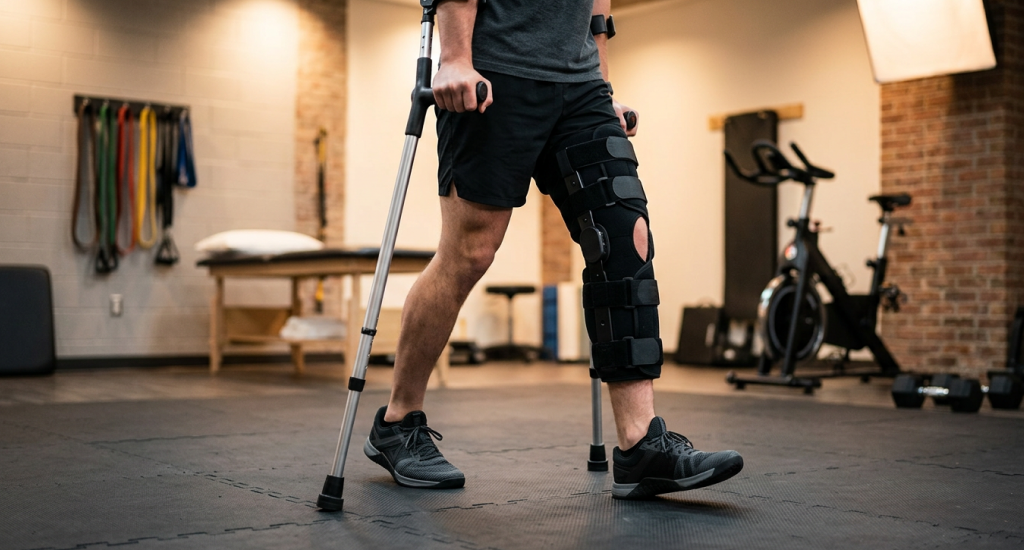
Many people can walk with a limp within a few days of the injury once swelling settles. After reconstruction, most walk without crutches in about 1 to 2 weeks. A meniscus repair can extend that by several weeks.
|
Milestone after reconstruction |
Typical timing |
| Walking without crutches | 1 to 2 weeks |
| Driving | About 2 weeks for the left knee; longer for the right |
| Desk work | 2 to 3 weeks |
| Normal stairs | 6 to 10 weeks |
| Light jogging | 3 to 4 months |
| Physically demanding jobs | 3 to 4 months |
One caution: walking on an unstable knee that keeps buckling can damage the meniscus and cartilage. If your knee gives way, get it evaluated before you push through.
What Speeds Up or Slows Down ACL Rehab?
Your effort and a few medical factors shape your timeline more than anything else.
What helps recovery:
- Completing prehab before ACL surgery
- Regaining full extension early
- Attending every session and doing your home exercises
- Building strength with blood flow restriction training while the graft is protected
- Getting enough sleep and protein
- Avoiding nicotine
What slows recovery:
- Meniscus or cartilage repairs
- Multi-ligament injuries
- Swelling that lingers
- Skipped sessions and rushed progressions
- High-demand pivoting sports
Younger athletes often regain strength quickly, but they also face higher re-injury risk, so speed should never replace testing. Consistent work on the right ACL rehab exercises is the most reliable shortcut there is.
When Are You Ready to Return to Sport?
Criteria matter more than the calendar. You are ready when you meet these benchmarks:
- No pain or swelling after hard sessions
- Full range of motion
- Quadriceps and hamstring strength at 90 percent or more of your other leg
- Hop test scores at 90 percent or more
- Confidence to cut, land, and compete without hesitation
Timing still matters too. Research shows athletes who return before 9 months re-injure their knee at about 7 times the rate of those who wait. At Rehabletics, force plate testing measures how evenly you jump and land, which turns clearance into a numbers-based decision instead of a guess.
Mental readiness counts as well. Fear of re-injury keeps many athletes from returning to their previous level, even when their strength tests look great. Rehearsing game-speed drills in a controlled setting builds the trust your knee needs before your first real practice.
Do You Ever Fully Recover From a Torn ACL?
Yes, most people return to an active life, and many athletes feel fully like themselves by their second season back. Physical clearance often comes before mental trust, so feeling hesitant at first is normal.
The long-term effects of an ACL tear without surgery can include recurring instability, meniscus and cartilage damage from repeated giving way, and a higher risk of knee arthritis. Surgery reduces instability but does not erase arthritis risk. Ongoing strength and movement training is what protects the knee for decades. A few minutes of single-leg strength, landing, and balance work each week after rehab ends is one of the best habits a former ACL patient can keep.
Start Your ACL Rehab in Cherry Hill
Your torn ACL rehab time depends on the plan you follow and the people guiding it. At Rehabletics, Dr. Jaime Mor and our team provide one-on-one, sport-specific ACL rehab from the first week after injury through return-to-sport testing. That includes prehab, post-surgical care, blood flow restriction training, and force plate testing.
Our clinic is at 5 Esterbrook Lane in Cherry Hill, NJ, and serves athletes across South Jersey. Book a free consultation and get a clear, personal timeline for your knee.